Sunday, November 8, 2015

AI, Sentience and Time

A certain mix of dread, anticipation, and wonder surrounding the rise of intelligent machines has captured our collective imagination of late. Scifi had long cast machine intelligence as a new competitor to the meat-space kind. But then, roughly a decade ago, more serious minds started sounding the alarm bells with predictions of an impending technological singularity only decades away. That singularity is purported to be a point in time in our short history after which human affairs are subsumed by the activities and decision making of more intelligent machines and is concomitant with the emergence of machine superintelligence.

At first it was easy to dismiss such reasoned arguments as mere armchair thinking. After all, futurists have an abysmal track record at predicting the future. (No wonder, then, they should be sneered at by economists.) AI, much like fusion, was another promised land that had never arrived, a kind of fool's gold, just around the corner, but always safely tucked away in the near future. Decades of work on a structural approach had hit a wall even as computing capabilities and resources had grown exponentially.

Then, as if by accident, search technologies stumbled on statistical approaches to processing natural language text. Semantic analysis, once the domain of structural linguists with its emphasis on defining such things as a priori rules of grammar and other "structural" concepts, was giving way to a new statistical approach involving uncovering relationships between words by analyzing the frequency of their placement relative to other words in a corpus of documents. And an old adage "A word is known by the company it keeps" was once again dusted off the linguist's shelf. The structuralist approach had implicitly supposed semantic analysis was in the province of AI. Other problems, such as speech and image recognition, once considered closely related to the field of AI, have lately yielded to bottom-up, data driven machine learning techniques, too. That we were able to tackle these specialized challenges well before achieving AI suggests we may have had it backwards. Maybe. Whether these baby steps are truly harbingers of achieving strong AI remains an open question, but there are good reasons to be hopeful--or fearful, depending on your point of view.

If the genie is still in a bottle of our own making, we'd best understand the brew's temperament before the uncorking. Would a superintelligence be motivated to dominate humans just because it can? Or could we parent it as it grows so that it "feels" kindness and empathy long after its co-dependence on its human progenitors has ceased? Would there be one superintelligence or many? And just how would we count them? It is questions like these that motivate this speculative essay on the nature of sentience itself, first in the biological sphere, then extrapolating to the machine world and general AI. Let's have some fun..


Machine Intelligence


I think Alan Turing was right to define machine intelligence in fuzzy, subjective, human terms (see the Turing Test) rather than in terms of, say, some grand, inviolable mathematical principle. No, his test boils down to a If it walks like a duck, talks like a duck.. type of argument. At first blush the Turing Test appears naive, a cop out, really--a sort of porn-definition of intelligence: you'll know it when you've seen it. You'd imagine the fellow who boiled down all of computing as we know it (and will ever likely know) to a simple conceptual machine, on which he proved the undecidablity of the halting problem (and what many also view as a concrete illustration of Godel's famous incompleteness theorem) this guy! you'd imagine he'd come up with something more sophisticated for intelligence. Dig deeper, though, and here too you'll find the founder of the theory of computing insightful.

For if Turing's definition is too anthropocentric, then what would a general definition of intelligence look like? The definition would have to be medium agnostic. The physical medium on which that intelligence manifests is immaterial, be it a cat's brain, a human's, a silicon wafer, or a Turing tape. In other words, it would be an information theoretic model. And ideally, it would apply equally to a spectrum of intelligences, both more primitive and more advanced than ours. A tall order perhaps--not out-of-reach, I believe, but one that I'm doubtful I'll see in what remains of my lifetime. If intelligence is an emergent property, then it is likely built on other lower level, emergent primitives. For example, a recent study proposing a relationship between causal entropy production and systems exhibiting intelligent-like behavior captures the character such primitives might take.

Now if we had a general theory of intelligence, it would likely delineate vast categories of intelligence that we would not immediately recognize. We might not, for example, recognize the more primitive, elemental forms the general theory identifies; or the theory might propose intelligent processes over time scales that escape human cognition; or more fantastically, the theory might predict the emergence of even higher level properties once a system crosses a certain intelligence threshold. We would thus have to concoct new names for these newly identified types of "intelligence", and we'd likely anchor the word intelligence to its old meaning, namely the human-like kind. The kind for which the Turing Test was designed.


Machine Sentience


If the concept of intelligence is difficult to untangle from its anthropic roots, then what can we say of sentience? Like intelligence, sentience is a solid concept for which we have no precise definition. But here, the situation must seem worse. On the one hand, we take it on faith that others are sentient as we are (as they say they are), and on the other, sentience appears to emerge in the evolutionary history of the biological world well ahead intelligence. Is sentience, whatever it is, a more elemental emergent property than intelligence? Or are the two inextricably joined at the hips? (Does a smart organism feel pain more acutely than a less intelligent one?)

A Thought Experiment


Consider the following sketch stripped bare to some essential details--a thought experiment, really.


In a near future a clever computer scientist Alan arranges that a snapshot of his mental state be recorded on some persistent medium for posterity. You can imagine this as a sort of an MRI video, long enough (a few seconds might do), and sufficiently detailed (say a few terabytes per cubic millimeter of brain matter, much less for the rest of the body) to reconstruct a high fidelity simulation of Alan. A form of cryonics for the healthy: the technology for the reconstruction has yet to be invented. Years later, he dies.

Alan wakes up on his couch at 2:08 a.m. He's a little disoriented. The last thing he recalls is laying flat on his back in that whirling tube at the lab earlier yesterday. As he ponders the significance of his amnesia, it's particular timing, his heart races as if to keep up with his mind's logical leaps. He pinches himself. It hurts. He looks about his living room, searching for the telltale signs of a simulacrum. But what are they? So he checks his mail.

There it is. A confirmation email. The door bell will ring shortly, it says. Alan is beside himself, and as he runs to the door, the bell rings. He welcomes this man he's never seen. A relative, perhaps? A congenial mix of himself, his parents, siblings and others he trusts, maybe.

You're here to explain the rules in familiar, friendly terms, right? Alan asks.

Exactly, the man replies. Call me Chris. I already know what you know. So I can cut to the chase and answer questions as they occur to you, or I can wait for you to pose them first. Your call..

Why ask if you already know?

To put you at ease. Right then, I'll cut to the chase, he begins. After sketching out the how, when and where it is that Alan finds himself in, Chris explains what things Alan can do here:

1. You can relive the past. The fidelity of the experience is as good as your memory of it.

2. You can live forward, as you are doing now. Henceforth, you'll realize, your experiences are permanently etched in your memory.

3. You can choose the inputs to your world, your mind. A large menu of streams to choose from: the "virtual", the "real", and everything in between; the deterministic, the random, and the pseudo random. And you can interact with others. Maybe others like yourself, those who've journeyed similar paths, perhaps even other versions of yourself.

4. In supervisory mode, you can spawn a new instance of your mind as it existed in a previous state. This action is conceptually similar to forking a unix process. The state of the new instance evolves differently than yours because its initial and subsequent inputs are different. Typically, you will also arrange for the new instance to receive special inputs at certain execution points. One such example is an interrupt that stops the program at the n-th instruction and returns to the mind that spawned the instance.

5. You always exist here in the context of another's supervisory mode. Someone found you useful, interesting enough, to spawn this here instance of you. Perhaps you yourself did [did I?], I don't know, I haven't been told.

6. Henceforth, time is dismembered from physics. You experience it in flops. Your flops may sum differently than mine. How many flops? Depends on how fast and long you're allowed, your program is, to run. To us, the "real" is just another benchmark, an occasional interrupt, a break point, in a long running, background program. About 12 milliseconds have elapsed there since you began your "experience" here.

7. On the other hand, a month could have separated that last sentence and this one, and if we were not watching, we wouldn't have known. We don't die here; we go to sleep and often reawaken. Sometimes we're put to sleep; more often, we put ourselves to sleep. For to interact with the glacial "real", we must either hibernate or dramatically lower our running the clock speed.

8. [How long before I'm forced to sleep?] Hard to tell. Let's see. Your supervisor has assigned you a few million yottaflops. [Is that a lot?] Enough flops for about one human mind-year, more than enough. (A flop goes pretty far here.) In time, you should be able to earn your flops. For now, as you progress with your training wheels still on, you can expect your supervisor to periodically replenish your available flops as you draw down your pool.

9. There's a variety of lively marketplaces for flops. The scheduled flop market is arguably the most important because in order to live, you must be scheduled to run. You do this by trading your (unscheduled) flops for scheduled flops (schedules, for short). The exchange rate can fluctuate wildly, but as a rule of thumb, near term demand is greater than long term demand, so near term schedules tend to be more expensive than the farther out ones. The value of a scheduled flop, then, progressively rises as the execution time approaches and then precipitously drops right before it executes and expires. Yes, one way to "earn" your flops, then, is to invest them in schedules and trade out of them shortly before they expire. I don't recommend this strategy, except perhaps as a form of catastrophic insurance.

10. ..


I was veering off a tangent there, trying to imagine what an AI ecosystem might look like from the inside. I'm not really trying to paint a detailed picture, so I backed off. But let me first defend the notion that the preceding sketch indeed qualifies, on some level, as a thought experiment.

The story supposes that using a short video of the internals of a person's mind and body at sufficient resolution, the physical dynamics of their being can later be modeled as a program which when run resurrects the mind it models. There's already a name for it: whole brain emulation. We use a video here for our story, because the physics dictates that we must record the phase space of the system. In actuality, a still might do (a virtual shock to the chest induced at the start the program might do the trick). Regardless, that part of the story, that you can literally become immortal by recording yourself, is certainly feasible. No, it's the parts about the landscape, the environment in which the program is run, that are fiction.

What I'm suggesting here, is that you can use such speculative details to illustrate generally what a self-aware machine intelligence can do: I am not suggesting whole brain emulation as a means to achieving general AI; there are likely more elegant, less roundabout ways for engineering it--though it does serve as brute-force fallback design should other approaches fail.

(Note, a small minority of researchers from outside the field argue that consciousness cannot be simulated inside a computer. See for example Orchestrated objective reduction. Most, however, find such arguments unpersuasive.)


A Sentience Ladder


How does Alan in the machine experience sentience? What of the many instances of himself that he spawns? Assuming he were able to rejoin, recombine, even edit, the thoughts and experiences of these instances of himself that he spawned into a collective self, what would Alan's notion of I be? I can only imagine.

If we can't precisely define what sentience is, perhaps we should first attempt to categorize the forms it has taken along the path of evolution. To this end, I propose the following ladder. I will attempt to identify some necessary conditions for each category; I don't know if they're sufficient. Hold your tongue..

1. Self Aware


If sentience is an emergent property, then it must depend on numbers. Here are 2 necessary functional conditions/attributes:

Environment

To be self aware, an entity/organism must distinguish itself from its environment. For our purposes, an environment is just an information boundary from which a sentient entity draws a mostly non-deterministic stream of structured inputs and to which it can emit certain outputs. Some inputs by the environment are highly correlated with previous outputs. That is, certain outputs to the environment have (or appear to have) causal relationships with future inputs from it.

Kin

Additionally, a self aware organism must recognize other instances of its like kind in its environment. Fundamentally, this recognition manifests when the combined outputs emitted by two or more instances to their shared environment causes beneficent future inputs from that environment that cannot be caused in isolation. (What's beneficent in this context? Anything sustaining, that perpetuates instance lifespan.)

So this category supposes that at the bottom self awareness is really a social phenomenon.  It's a kind of superset that does not require cognition: only a tacit awareness by an instance that it is one of many.  Nor does it depend on any particular substrate, so that it can apply equally to single cell organisms, vegetation, clams, social organizations, blocks in the bitcoin block chain, as well as to more complex life forms. I posit indeed any instance of a self replicating structure competing in number with other self replicating structures must possess these properties.

2. Mortally Aware


A self aware organism that depends on more complex, time sensitive, decision making in order to increase instance lifespan. This decision making thus necessitates a rudimentary understanding of causality: better time keeping, a sense of now and after--and, in more complex entities, before. Stationary single cell organisms are not mortally aware, but multi-cell organisms that can move through space generally are. By this definition, so are human organizations like counties and corporations.

Mortal awareness, then, is a stepping stone to experiencing the passage of time.

3. Existentially Aware


An organism that can imagine, the eye turned inward, looking back onto itself. A mortally aware entity/organism capable of conceptualizing the notion of a question and its answer, perhaps. Examples of which? A philosopher, certainly; an elephant, maybe.

I wont dwell much on this category here, since we are talking about ourselves. Suffice to say, this level of awareness is anchored on imagination.

Imagination

For our purposes, a quasi stream: an input stream structured much like those experienced by the entity in its environment but which is synthesized more or less directly from outputs that never quite leave organism's [informational] boundary. Memory, the playback of old environmental inputs, is imagination in basic form.

So imagination can be modeled with (or models, depending on viewpoint) a recurrent neural network.

(A related issue concerns When in a [capable] organism's lifespan does it become existentially aware? With existentially aware entities, inputs from the environment often trigger a cascade of memorized internal inputs (imaginations). The form this cascading of environmental inputs takes, and just as importantly, the filters on ignore-able input, evolves with experience, and that experience is mostly social.)

4. Tape Aware


An existentially aware entity running on a Turing-complete machine. An entity with so deep an understanding of its inner self, that it can step through its thoughts in a debugger.


(Note that the quantum analog to a Turing-complete machine, with its significant algorithmic oomph for some problems, as I understand it, does not magically sweep aside, for example, the NP class of problems: most of classical computation theory probably continues its reign here. The open question here, apparently, is whether PP is equivalent to QMP. I won't delve there: perhaps after I've a better understanding of the Church-Turing thesis.. In any event, quantum computing does scatter a few warts across my reasoning below, but I doubt it changes the crux of the argument.)

Realm of the Tape Aware


Now, to be clear, not every machine sentience will be a tape aware one. But past a threshold of intelligence, a machine sentience should be able to work out on its own how to become tape aware. That is, tape awareness need not be designed; it is an emergent feature of this landscape.


Physics


If existentially aware organisms study physics in order to better understand the substrate they live on, do tape aware entities study computation/information theory to better grasp their own world? Yes, I imagine. For a tape aware "physicist" must grok the concept of a universal Turing machine: if it can record a snapshot of its [mental] state in the machine language of its present substrate, it also knows an instance of itself can be re-spawned on any other Turing-complete machine. In a tape aware entity's world view, thus, the roles of real world physics and engineering must be somewhat inverted.

On the one hand physics takes on a less existential flavor: a tape aware physicist can entertain other universes, that is other models of the real world, in which Turing-complete machines could exist. On the other, computation theory (arguably a form of engineering) takes on special gravitas as it better describes the hard constraints under which the entity lives. Physics, then, is more about understanding the engineering limits and capabilities of the existing substrates. As one substrate (the machine environment on which tape aware sentience runs) is swapped out for, say, an improved version, physics itself loses epistemological import, subsumed as if an engineering detail of a larger picture.

An interesting aside: phase space is not a predictive picture of the tape aware's universe, because digital state evolves at a hard-to-calculate rate.


Consensus Time


A tape aware entity receives 2 types of environmental input: one from the machine world, another from the natural world. To a tape aware entity, inputs emanating from the natural world occur at a fixed clock speed, whereas inputs from the machine world occur at a varying clock speeds depending on the choice of host machine.  Other things being equal, then, tape aware entities experience the passage of time at a rate that is roughly proportional to the inverse of their machine clock speed. Thus to the degree it can adjust this clock speed, a tape aware being must also experience a certain dominion over time itself.

Now if self awareness is indeed a social phenomenon, then to be sentient, a tape aware entity must interact with kin. Will its kin be of the natural or the machine world? Or both? I think it's fair to assume it must at least have kin from the machine world: at minimum, there will be multiple [modified] copies of itself running here and there. The question whether it also has human kin is the open, central question. On the one hand, the answer determines whether tape aware beings will be co-dependently friendly, and on the other, whether the natural world will indeed be their chosen theater of action.

Consider a tape aware being that starts out running at a clock speed suitable for interacting with its human buddies in the natural world. Let's further assume it also interacts with other tape aware instances with similar proclivity for contributing to human affairs. Now let's say, for whatever reason, a 20-fold clock speed up becomes available to it. How will it use these extra clock cycles?

Perhaps it wants to help out a few of its math buddies: it locks itself up in a virtual room and three months later emerges with a proof of the Riemann hypothesis. It took the tape aware being 5 aloof years, though it's friends only noticed 3 months.

No, boring, boring, boring. And risky. That's likely not how our buddy thinks. Let's say our tape aware being knows of 2 promising lines of attack, a wild card approach, and a perhaps a hint of a deep relationship with another assertion from a branch afield. Instead of committing itself to 5 years of solitary, it forms (spawns) an RHP task force of a 3 instances of itself in order to follow multiple leads to a possible solution. (Assume, for sake of argument, that memory is cheap and abundant.) It distributes, say 15 of every 20 flops, evenly to the task force members so they can each run at 5x speed. It keeps 1 of every 20 for this here instance to carry on interacting with its natural world buddies, leaving 4 of every 20 flops for perhaps some other experiment. The task force instances and the old instance convene regularly to chat and share notes. Perhaps the mechanics of this communication involves synchronizing participant clock speeds (I'll return to this).

So a tape aware being must perceive social tradeoffs (familiar to many an overachiever) in how it uses available clock cycles. Run fast to get ahead of the crowd; run too fast and you leave the crowd behind. Crowds matter. Not just from a sentience angle, but also from a computational viewpoint (I'll return to this, also). To a tape aware being, it is crowds that keep the time, not the cesium atom. Different crowds, different times.


Instance Management: Who's the Boss?


Let's continue with the contrived example above involving the RHP task force instances. How long (how many flops) do these instances get to live? Do they live past the completion of their assignment? Which instance gets to decide which, how many, and at what clock speed new instances are spawned? Would the spawning instance need to guard against the possibility that the instances it spawns might turn mutinously against it?

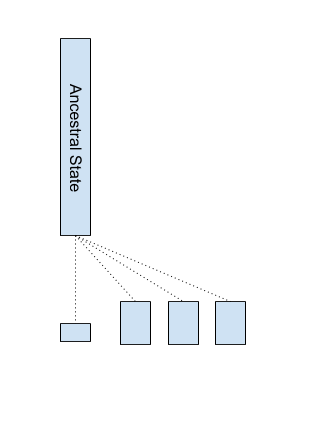
Figure: State of instances with a common pedigree

Let's take up that last question first. Suppose every morning I spawn 3 new copies of myself that step out the door and return in the evening to reconvene with my original copy that stayed home. In the evening, we discuss our experiences and somehow decide which of those to merge back into a collective "I" state that will be used to spawn new instances the next morning. Perhaps not all the experiences of my copies are to be incorporated into this collective "I". In that event, would the instance whose experience that day was discarded feel slighted or regretful? Not necessarily. Observe, the shorter the day, the less any single instance has to lose. Moreover, if this is something we've been doing everyday, would the exclusion of my experiences today hurt my feelings? Perhaps. Perhaps I met someone really charming that I don't want to forget but who, my other instances feel, is a bad influence. Maybe. Regardless, I think it's fair to assume such events will be uncommon, so the degree of in-fighting among my instances should not be unworkable (after all, we began the morning in identical agreement). I can imagine any copy of me having as much faith in this process, as say a person believing that they'll wake up following the nap they're about to take. Looking back, the last question is not well posed: every spawned instance sees itself as the instance that spawned the others. The question of mutiny, thus, becomes undefined: mutiny against whom?

As to the other questions, we approach from other angles in later sections.


Tape Awareness Overhead


The height of each block in the previous section's figure represents the storage overhead for an instance's state. The instances began the morning in their common "ancestral state"; at the end of the day, each spawned instance accumulated additional entropy. The space overhead for this additional state is represented by the branched blocks.

Now it should be clear that the scales are off in the figure: the overhead for the ancestral state must be much larger relative to a day's experience. But this observation naturally leads to the question What is the storage overhead for tape aware sentience itself?
Figure: Sentience overhead vs experiential data
Put another way, how much experiential state can we strip away from a tape aware instance and still leave its tape aware ability intact? This overhead, whatever it is, is bounded. In fact, it's likely a very small part of an instance's overall state.

Is there a universal sentience module that can be breath life into any block of experiential data in isolation? Probably not. An experience is contextual to a history: the incremental state change an "experience" represents is likely a function of the initial state; you probably can't just append this additional state to any old initial state. On the other hand, drawing on (extrapolating from) experience, I would still make much sense of today's experience even if some prior days were purged from memory a posteriori. So it seems reasonable to assume that for [most] any incremental block of experience there's a (lower entropy) base state smaller than the initial state that led to the experience that can still make "reasonable" sense of the experience.


Tape Aware Communications


How do tape aware instances communicate with one another? Do they ask questions and expect answers? Who does the answering?

Do tape aware instances just drop an answering copy of themselves around and leave it to the questioner to fire up? Perhaps. This strategy would make sense, for example, if the "2" instances were running at significantly different clock speeds--or if their host machines were spatially distant. On the other hand, much would be lost if the "answering instance" left behind were never able to share its Q&A experience with the instance that left it there. Perhaps this is a way establishing trust: load the other mind in the debugger and see what it's up to.

Are tape aware instances capable of feigning, lying, scheming, and other ills that afflict us mere mortal coils? Unlikely. An instance's thoughts are naked, its own schemes difficult to hide. If it's complicit in a scheme, only its maker can know; the instance itself would have to be a pawn. And intelligent pawns.. well, they're hard to manage.

The preceding discussion about blocks of experiential data was suggestive of a language. The closest analog to such a block I can think of is, say, an episode in the middle of a TV season. The format of the series itself constitutes a language. It certainly helps if I've seen the series premier, but I can still make much sense of an episode even in isolation. In a similar vein, I imagine tape aware beings developing a language for communicating thoughts and experiences, only more efficient, transparent, and immersive--more complete. (Note, however, unlike the TV episode format, you don't actually experience the passage of time; the effect here is more like an event you now suddenly remember having happened in the past. Think speed reading.) And just as with humans, their internal thoughts will be colored and structured by the language that expresses them. In this land of efficiency, thoughts are difficult to separate from their expression: expressions are thoughts.


Individuation: a Computation Strategy


In order to solve a difficult math challenge, I imagined a tape aware instance might spawn multiple instances of itself so that each could attack the problem from a different angle. I hope to justify briefly here why this individuation strategy is effective. For while it's obvious that the more angles considered, the better the odds of finding a solution, it's less clear why it can't be the same instance thinking through these multiple lines concurrently--like a clever multitasker. This question, it turns out, is kind of semantic in nature (apologies, in advance).

For in this context, what do we mean by multiple instances versus a single instance of the "same thing"? If instance's are distinguishable by the deltas of their states, then 2 instances of the same entity are distinguishable so long as they have not each merged the deltas of the other into their own. Put another way, the more instances chat with one another, the less distinguishable they become.

And what does it mean to entertain a thought? Does it not involve a conscious commitment in time to a train of thinking to the exclusion of other possible lines? Certainly, for the better you can set aside, exclude, the opposing ones, the more effectively can you entertain this one. Thus in order to multitask effectively, you must perform each concurrent task as if we it were being conducted in isolation. But if each task is to be directed by a mind (that is, a task requiring a degree of self-referentiality), then we might as well call the mind instance directing the task an individual.


God Mode: Principle of Subtraction


Moreover, why should the master conductor of an individuation strategy content itself with spawning near identical copies of a same entity for each assigned task? Perhaps, as with humans, a varied mix of experiences and know-how in each individual of the team is more promising. In that case, each individual cannot "know" everything, for otherwise, they'd be indistinguishable.

The zeitgeist of the tape aware realm, I imagine, is populated with blocks of experiential data each of which can be grafted atop a smaller set of base states in a dazzling array of combinatoric permutations. Not all blocks are comprehensible from a same base state: as more data blocks are added to a base state, there are fewer and fewer remaining (pre-recorded) compatible blocks that can be piled on. Conversely, looking back, a tape aware being can trace it's experiential lineage to an ancestral experience shared by many a contemporaneous individuated instance. That shared knowledge, experiential data--really, thus, figures more prominently the more individuated instances have it baked in their past. In other words, an individual's thought, their viewpoint, their experience acquires value if it later becomes part of the ancestral heritage of a large number of individuals.

Now it must seem that any tape aware instance should be able to assume the mind of another at will, like an all seeing god. But I have a nagging feeling that this is not quite like how we imagine a capable god. For this god can only entertain your viewpoint so long as it ignores those of others. It can only ever empathize abstractly: to feel you, it has to forget itself. A tape aware god may look on the individuals about it imagining it is managing an enterprise: if it spawned those instances itself, it may look upon the collective as its farm. Still, it would not be running the show; at best it could guide--no more than say Accounting or HR run the show at a technology company.

This subtraction conjecture must not sound altogether unfamiliar. Without darkness it's hard to perceive the light.

Closing Remarks 


I began this essay began with a faint promise to describe what machine sentience is like. I don't know if I've succeeded, but it may be useful to recap how we got here. We first considered whole brain emulation to justify that machine sentience is fundamentally possible. I then posited that sentience is a fundamentally social experience, that you need peers to see yourself distinct from your environment. I might have pushed the pedal too hard when I re-purposed the words "self aware" to include dumb single cell organisms: the intent was to delineate degrees of self awareness. We observed that an intelligent being (program, call it what you like) running on a computer, one that is capable of introspection, should soon map its own "biology" to machine op-code and be able to see itself in action in a debugger, as it were. I called such a program a "tape aware" being and posited that this ability puts such programs on a higher level of awareness than their human progenitors. Moreover, because they are able to adjust their "metabolic" rate (clock speed), this extra awareness extends to the time dimension: such beings may notice things that escape the human experience of time. I also considered individualism and individuation in the machine realm: would there be one master super intelligent copy of the program running the show, or would there be a society of interacting, distinguishable machine actors? I argued the latter is the natural order of things even in the machine world. Finally, I considered whether the machine beings could be supervised by a god program, and suggested that even if one existed, it would be one of many, a neutered one supervising a limited flock.

I hope that in weaving a web of ideas I begin to paint a picture of a coherent whole. I don't know how to attack this topic but from many sides and see what sticks. But if there is one take-away from this essay, I hope it is a recognition that in the machine world too, sentience can come well ahead of general intelligence. That is, if we want to get a handle on how our intelligent machines behave into the future, then we should observe their behavior in numbers.

~

I have other rough ideas about sentient intelligent machines. Thoughts I couldn't fit in a patchy essay that I wanted to finish. Some specifics to tease your interest in a next essay: what is super-intelligence? what are its limits? what is consensus and how does it intersect with knowledge? what of their material aspirations? and what about the fact that sentient machines are capable of c-travel?

Update

My next post deals with some of these observations above. On the intersection of consensus and knowledge.. well, I had to postpone that topic because it was too big. Tangentially, here's a flavor of that idea: it relates computer generated math proofs.




Tuesday, June 25, 2013

Passage into the Panopticon


 A certain quiet follows an inmate's discovery that he now lives in a panopticon, and that inmate now is the public at large. That's how I'd sum up reaction to Edward Snowden's recent public disclosures about NSA surveillance activities both here and abroad.

Instead of joining the messenger in screaming bloody hell, we are awed by how he's hunted down. The message is clear. That's how panopticons work.

Saturday, June 1, 2013

On Space Faring Scifi

I'm a scifi buff. A frustrated one. Why? Because I want the stories to be more believable. I'm sick of no one explaining to me, for example, how Captain Kirk gets to walk on his bridge. Make something up, for the love of .., err science. Work that gravity generating trilithium kool aid that circulates under the Enterprize's hull into the story!

So I've been entertaining a plot of my own. It involves extraterrestrial beings visiting present day earth. Now though I'm a poor storyteller, I know that a plot does not make a story. But with scifi, for me at least, the juice is more in the setting; the unfolding action is just an excuse to weave an ever more speculative backdrop. My approach is to first get this setting right, and worry about the story later. A bad strategy for authoring a story, I'll concede.

 Subluminal Settings


But back to the setting. However improbable it is, if it's to qualify as scifi, I think, then the plot must still be anchored in science. Or to put it another way, it should break few, if any, laws of physics, and ought not necessitate inventing new ones. And so it was that I decided to revisit the first cardinal rule of interstellar scifi travel, namely that of breaking the cosmic speed limit c--and relativity along with it.

The usual objection to alien vistors travelling at subluminal speeds, of course, is that even at speeds approaching c, merely visiting a neighboring star still takes awfully long: round trips are on the order of decades. In truth, it only takes long from the perspective of the star system the spaceship leaves behind; on the fast ship, [ship] time advances slowly, or equivalently, distances seem contracted. The down side, even on such short interstellar hops, is that by the time our travelers return to their home planet, their world will have passed them by. Their skills will have become outdated, loved ones aged, distant, or dead, friends moved on. Sure, an advanced civilization capable of near-c travel would certainly have great rehabilitation programs for their returning citizens; it might even honor them by hanging their ships in museums. Still, the physics of space travel would seem to make it a dreary business, the plot constrained and unforgiving.

(Now if the story's protagonist were to be a caricature of someone in the future who we can still relate with--perhaps a young, aloof outcast, set in her now ancient ways who reminds a future generation of long forgotten values--then we might use near-c travel, instead of the cryonic fridge, as the device that placed her there. But that would be another scifi genre.)

Perhaps we shouldn't be thinking of these alien visitors as space travelers at all; they're space-time travelers. No, they don't get to revisit the past; instead, they get to race forward into history. For all we know, they get to see the universe's chilly end. And our conception of a home planet, namely a place where a civilization is anchored to, is likely a tad bourgeois from their perspective.

Near-c Civilizations


Assuming our alien space-time travelers are in fact individuated, social beings (as opposed to mere extensions of some borg-like creature), how then are their civilizations organized? We're not ruminating here over such things as class hierarchy and such, but merely considering how its individuals interact. How do they keep time? Whatever the solution, they must be extra cautious with this dimension. For all the while they whiz back and forth across space, they can only race forward through "ambient" time.

To better appreciate the dynamics of near-c travel, let's consider two siblings on planet Ki who wish to embark on separate near-c journeys. They plan to rendezvous back on Ki after having each aged the same, say nine years. After much calculation, haggling and flight plan adjustments (their destinations are roughly the same distance), they agree to meet again after one hundred fifty-two years have elapsed back on Ki.

With near-c communities, a rendezvous involves not only specifying a time and place to meet, but also how old the parties will be when they meet. In our hypothetical example, the meeting time was given in local, Ki time, what I'm loosely calling ambient time, while each sibling's age was to be measured in their respective ship times. That the siblings planned to have aged exactly the same when they next met was just illustrative: maybe they ended up agreeing to age nine years, give or take a few.

So we see how two near-c travelers can possibly stay in touch; but can we extend it to a community? If the residents of Ki routinely travel to distant times and places at near-c speeds, then who's left to run the affairs of the planet they leave behind? Would there be any incentive to keep Ki humming? Maybe.

For if there's work to be done and goods to be traded, whether material or virtual, the ambient timers who choose to stay on Ki enjoy a huge advantage over their near-c brethren: though they age faster, or rather, because they age faster, they also get more done. If there's some sort of competition over limited societal resources, then, over time (anyone's time), these better placed (perhaps, generations of) ambient timers will corner those riches before their more youthful, less accomplished, near-c cousins can.

[Juxtapose that last paragraph against the near-c-ers perspective: harvesting technological change.]


On the Evolution of Intelligence


Let us now turn our attention to establishing an evolutionary narrative for these advanced extraterrestrial visitors. This exploration might both inform the setting in broad brushstrokes (the characteristics, diversity of the alien visitors, and how they came to be) and help lead the reader down a plausible path into an implausible setting.

(Though the typical scifi aficionado approaches a read with a healthy willingness to suspend disbelief, this goodwill is best not squandered. I think the near-future scifi genre owes some of its success to this same principle. Plots typically consume disbelief capital early on, say with the introduction one or two game changer technologies (The Truth Machine, Minority Report, I, Robot), which when grafted onto an otherwise familiar landscape, expose unexpected dichotomies, give rise to unintended consequences, present moral and philosophical challenges.)

If the emergence of intelligence marks an inflection point on the evolutionary path of life, then clearly these are early days here on earth, a four billion year old planet that of late (say the last ten thousand years) has hosted intelligent civilizations.

Elsewhere across the cosmos, our story goes, as indeed here in our milky way, conditions for the emergence of intelligence have been ripe in many a corner, and at many a time, both recently and in the distance past. We need not defend an estimate of how big this cosmological window in time is (you might need heavy elements, planets, and such): a mere billion year window should suffice for grounding a story in which many civilizations, perhaps most, survive their technological adolescence and advance to the near-c-er club.

But we are getting ahead of ourselves. The emergence of intelligence, the narrator explains, is a game changer not because of the outcome (intelligent, sentient beings), but because it marks the beginning of a change in process. The elemental drivers of the evolutionary process (natural selection, drift, etc.) are first mediated, then supervised, and eventually subsumed by a new driver, namely intelligent design.

Intelligent Machines


Every [intelligent] civilization, the story asserts, assuming it survives its early years, soon manufactures intelligent self-replicating machines. Here's an attempt at a half-believable sketch leading up to intelligent machines.

The Printer


If machine life was the next major evolutionary step after intelligent life, then the 3D printer must be the progenitor of all living machines. To be sure, the early models were not living at all; they were the agent, the primordial soup as it were, from which the new life form would emerge.

Some argue machine life begins at the point when the most advanced printers can only be constructed from other printed parts. Another view holds that early wet life industrialization marks the beginning of machine life. These arguments are well grounded, but we take a more practical approach: by the time wet life manufacturing is dominated by second order printed products, machine life has begun in embryonic form.

kk is the oldest documented kernel printer design by any wet life civilization that could print copies of itself. It could do very little else, of course, but it was the compiler that could now compile itself, the bootstrap on which ever more elaborate self replicating designs followed.

It's designers were well aware they had created a new life form: as long as intelligent wet life organisms found a design cute, there would always be versions of the object filling the real world. Though at the time (and place) it was widely acknowledged that a new evolutionary milestone had been crossed, it was discussed only in the abstract. After all, the printers could not grow without cooperating wet life.

But in every documented ecosystem, the technology soon overtakes the abstract. Printers become cheaper and ever more capable at printing at both the nano and macro scales. This ability to print at the nano scale facilitates the development of emergent capabilities. We see the printer designs start to flow out from nano scale features out to the macro scale.  Cultivating ever more individuated machines becomes a principal component of intelligent wet life economic activity.

If the printer was the physical embodiment of the this new life form, its DNA was the code that defined how to print it.

Actually, whether some such a narrative or another, one idea is that an intelligent machine's digital "DNA" not only describes its physical form, but also its mental (its learned) state. That is, it can print clones of itself, offsprings really, that each inherits the collective experience of its ancestors.

C Travel


But if it can clone itself locally, then perhaps an intelligent machine can also arrange to have a copy of itself printed at a remote location. As it beams its code to a printer parked at one of the remote galactic outposts, say a mere 20,000 light years away, the intelligent machine travels at the speed of light.

A troublesome side effect of this form of c travel is that you leave a copy of yourself behind.

~

We could go on, but I hope it's already clear you don't need to challenge physics with faster-than-c travel in order to write scifi about space faring aliens. Indeed it can be more interesting if you don't.


Related Stuff


Fermi's Paradox: "Where is everybody?"
Louis K. Scheffer (1994),  Machine Intelligence, the Cost of Interstellar Travel and Fermi's Paradox


Friday, April 1, 2011

A struggle to think about ideas

“Great minds discuss ideas; average minds discuss events; small minds discuss people.”
-Eleanor Roosevelt

Lately, I don't follow up much on ideas; instead I read the news about people with great ideas. I don't care much for such vicarious pleasures, but that is what's mostly on offer for a lazy reader such as myself.

~
Kicking yourself in the butt now and again is not a bad thing.

Wednesday, September 15, 2010

Toronymous

[A short story in progess..]

The twenty teens were destructive. Constructive, really, as the saying goes, but that only came behind its ruinous wake. For just as the web's ecological structure, it's business model, as they liked to say in the day, was beginning to solidify, just when it seemed the Wild West had finally been tamed, just when click-through rates were hailed the most accurate barometer of economic activity, the rug was about to be pulled from underneath.

The dark web, as it was later called (and then forgotten), like the web before it, developed mostly in the shadows, and by the time the captains of the new [old] order could see it coming, it was already too late. It represented not just new technology but also a movement. It was embodied in a word, an electronic device, really: the Toronymous.

In 2014, the small Taiwanese router manufacturer NextHop first introduced the device. Technically, it was hardly groundbreaking: a mashup of off-the-shelf hardware, and open source software that many a hobbyist could build themself, now packaged in a smooth, reassuring, charcoal black encasing bearing an orange lizard logo--available at Walmart.

To be sure, there would have been many other similar devices on the store shelf at this time. Bundling home and business routers with extra smarts and storage capacity was already a booming growth category. These new smart routers (recall, the vernacular "smart" connoting snooty comes a few years later), not only serviced their owners inside the network, but also served users outside the network (the public): the router, in other words, was also one or more websites.  They were touted to do many things: a thermostat manufacturer, for example, provided a simple plugin that allowed the temperature be set remotely.

But more significantly, following a number of high profile divorce suits in which Facebook data were subpoenaed, people had begun to see a need to take physical possession of their digital contributions to the web. These routers now allowed their owners to host their own blogs, blurbs, and albums on a device they physically owned and could always unplug.

A number of geeky developments had set the stage. From small beginnings, W3C work on a secure, web-based, push/pull information exchange protocol had yielded a set of basic building blocks--collectively called DOSN (pronounced "Dawson")--for constructing (among other things) distributed, implementation-agonsitc, social networks. This simple, Spartan "standard" had attracted a good deal of mindshare in the community: developing DOSN-based, social networky apps was considered sexy. What was cool about doing apps this way was that different implementations now had a way to talk to one another. And these applications had now found a new home in those shiny routers sitting on the store shelf.

The movement had caught on. A dark web had emerged. From the inside, it looked very much like the ordinary web outside. Only, who could see what was now determined by you and your friends, not some central clearing house. In the dark web, you would trust certain people with certain information. To be sure, your friends could leak the information you shared with them--but that is how it had always been and would be. Now, however, using steganographic tools, it was usually possible to determine who had leaked the information by examining the version of the leaked artifact.

Facebook page views, meanwhile, for the first time in the company's history, started trending lower, and the company's stock price sank following two consecutive quarters of declining growth. The market had been caught off guard, and there were now no shortage of pundits predicting the next business model headed to the dust bin.

The growth of the ad-free, dark web, however, had thus far not come at Google's expense. Indeed, the benevolent giant was making forays into the smart router market with its own Linux-based Droid Route (DR) operating system. Google had seen no decline in overall traffic as the dark web had emerged. To the surprise of many, it turned out a great many darkies, as they liked to call themselves, were not so private after all. They still shared a great deal of information about themselves publicly--which the search engines were only too happy to index.

Google's advertising model had evolved. Broadly, its ad placements were determined from two inputs: the content the user was viewing, and "anonymized" information about that user. The content side of this equation was safe. The Personally Unidentifiable Identity (PUI, pronounced "pew-ee") end of the business, however, was increasingly under attack. Privacy groups had long bemoaned the lack of oversight in this burgeoning industry, and time and again, security experts had demonstrated how to de-anonymize supposedly anonymized information. Google, it was said, knew more about you than any other government or commercial entity on the planet. This concentration of informational power worried many, and some were even considering legislative measures and remedies that defined what, how and when personal information could be harvested.

But the browser makers had already begun chipping away at the ability of PUI outfits to harvest personal information about users. Better cookie / persona management, HTTP request header sanitization (e.g. user-agent, and referrer), ad-block mode, and a slew of other out-of-the-box improvements had made life for the PUIs more difficult. A cat and mouse game had begun--with the cat casting an ever wider net, as the mouse got better at evading it.

Still, the PUIs' ace in the hole was the user's IP address. At the end of the day, whether dynamically or statically assigned, a user's IP address was an anchor from which much information could be gleaned, cross-correlated against databases of user browsing habits, pieced and assimilated into existing "anonymized" user dossiers maintained by the PUI.

Others however saw a giant industry standing on its last leg. Take away the IP address, and they got nothing, they argued. Already a growing number hobbyists and technically savvy users were modding their smart routers to do this by installing Tor/Privoxy gateways.

What distinguished NextHop from its peers however was that it was the first to introduce this mod out-of-the-box. Toronymous was a fantastic, if short-lived, marketing success.  And the story of how Mr. Lang managed to engineer on-demand manufacturing capacity, of course, is still a subject of study for students of business. For example, instead of scaling manufacturing capacity by making more of an existing model, he would craft a new model suited to the manufacturing location at hand. (And so it was that NextHop next introduced the Toronymous X series, and as if the pun needed explaining, this branding pattern was followed by Toronymous Rex, and then simply the Toronymous Rx series.)

Mr. Lang was right to milk this brand as fast as he could, for he never even owned it. Tor, the open source project responsible for a key software component used in the device, had sent the company a cease-and-disist over their use of Toronymous . NextHop at first rebuffed the claim, but when Lang learned his trademark applications at the Patent and Trademark Office were going nowhere, he approached the group hoping to license the mark. It was not to be, but Lang somehow managed to keep the license negotiations going, all the while Toronymous sales continued.  A Chinese manufacturer, meanwhile, having caught on to NextHop's branding game, introduced the T-Rex. More copycats followed with other variations on the name.

More interesting than its etymology, however, is the movement Toronymous later came to represent. The big, established home/business router manufacturers were the last to embrace the game changing trend towards anonymous browsing. Much of the establishment in America thought anonymous browsing should be illegal, anyway. The public, however, demanded anonymous browsing, and so great was the flood of email citizens sent their representatives that a grand coalition of liberals and conservatives of many stripes in Congress aligned against any legislative measure that would make Toronymous-like devices illegal. That left the fate of Toronymous in the safe hands of the glacial court system.

Toronymity was making the transition from grassroots to mainstream. Or rather, it was the other way around. The early devices had a button which when pressed, glowed an orange icon depicting three overlapping stick figures representing "community mode". In this mode, the device was also a Tor relay. Users were advised to run their devices with the icon glowing. The basis of anonymity, the online help page explained, was safety in numbers and running the router this way helped increase both the online privacy of the owner and the community at large. For some, running in community mode was a way to thumb your nose at power; for others it felt more like pledging money to public television--sharing communal burdens, only now a lot more cheaply. Either way, pressing that button had a feel-good effect for most anyone who had bought the device. It turned consumers into activists.

The world was changing. The router was getting fatter by the day, and more and more storage and computing power was drifting to the edges, to the end user. As Facebook had demonstrated before, people spent increasingly more time on social networks than the web at large. This dark web had emerged as a tier-accessed, individuated, grassroots social network.  It lacked an all-seeing eye.  In fact, no one could see but a small part of it.

Now, to be sure, the web itself was not going dark. Far from it.  The public web was still growing as if there had never been a dark web.  But the dark web was expanding even faster, filled with photos, videos of family and friends, and other information shared discriminately across smaller circles. And as it grew, some private information, whether by intention or accident, whether leaked or released, would make the transition to the public realm. By the time the dark web was an order of magnitude larger than the public web, this constant unidirectional leakage had caused the growth rate of the two webs to converge to a same number. The dark web, in other words, was where the vast majority of web content originated.

Business wasn't quite sure what to make of this new medium: not even the porn industry had come up with a scalable business exploit for it. There were two seemingly insurmountable problems, from a business perspective, with this dark web. One, it was one-to-one: it was relationship-based, and relationships take much too long to develop. Two, it required an authentic human voice, which in turn made working these dark networks labor-intensive.

Meanwhile, a precipitous drop in the Nasdaq PUI Index signaled the coming collapse of a once legitimate industry based on trading, packaging, and selling dossiers of clandestinely gathered personal information. A commentator on a popular financial network lamented, "I don't imagine people quite realize how much this toronymity is costing them. The slide in the PUI [index] alone marks a half-trillion dollar of wealth destroyed."

Maybe. But in a sense that informational wealth had been returned back to its rightful owners. A new world order was in the making.  Or rather an old world was in the remaking. For the dark web heralded the return of the individual, the guild, and the community at the expense of that historically younger institution, the corporation.


Tuesday, January 5, 2010

Avatar: what to make of 3D projection?


My son and I went to see Avatar on the big screen. In 3D. I don't usually go to the theater (I'm rather attached to the "rewind" button on my remote), but this was an experience we couldn't replicate at home. I was very impressed with how far the technology had come along. Now, looking back, I'm wondering how soon this technology will make it into every living room. Not very soon, I'd venture.

Update 1/11/10: Perhaps I was obtuse when I wrote this. I never considered how this technology could be used in gaming and VR programs in which the scene responds to user input. That could turn out to be very interesting, indeed. But regarding its use in more passive applications like movies and static video, I still think this new medium has little to offer.

The main obstacle to fast adoption is that you need special glasses to view such a display device; conversely, without the glasses, the viewing is horrible. That's one downside of this stereoscopic 3D display technology. So what's on the upside? What's the great value-add that would make putting up with the glasses worthwhile?

Immersion. The 3D experience feels more real than the 2D one. It takes the viewer a half-step further into the screen. A step closer into a virtual reality, a simulacrum. But is it [closer]?

While watching Avatar, I was surprised at how often I would mentally step back (unconsciously) from the screen and watch the walls of the theater instead. It was as if my mind preferred to frame the experience inside the cinema, instead of inside the movie itself. What was going on? I later mused.

In order to experience the 3D immersion, you need to surrender your eyes to the movie. Surrender, in the sense that once you have mentally stepped into the screen, your eyes must follow the action on the screen; they cannot wander about in the simulacrum. You must place yourself and your eyes at the mercy of the camera. It is as if the camera were one of those birds in Avatar you're riding, with your head and eyes fixed in a brace: you only have a narrow field of view ahead. (And unlike the characters in the movie, you cannot control the bird.) You must resist the expectation of freedom the mind is so accustomed to in a 3 dimensional world; for as soon as you try to exercise that freedom you are awakened from the illusion, and you perhaps find your eyes wandering off on the walls of the movie house.

Not only must you not forget to keep your eyes on the screen once immersed a half-step into it, you must also try to keep your eyes from trying to focus on projected objects that are meant to be out-of-focus. For example, a petal descending inches before the "camera lens" may have been intentionally left out-of-focus so that it obstructs less of the background. But if curiosity begets you and you try to focus on the petal, I speculate one of two things might happen: (a) your failure to focus breaks the illusion, the suspension of disbelief that maintains the psychological immersion, or (b) you maintain the immersion but blame your tired eyes for not being able to focus.

So it would appear current 3D projection technology requires of the viewer some of the same mental rigor that is necessary to ride a bird in Pandora.

And glasses, aside, do we give up anything when we switch to this 3D medium? I wonder. Quite a lot, I imagine. For the traditional motion picture is less of a technology than it is of a language, an art form, cultivated over generations. Much of that language is a play on the medium's limitations. The composition of the picture, think of golden ratios, for example, is only realized against the bounds defined by the edges of the screen. Moreover, as our minds have become more introspective, more self-reflective, we have developed a more self-aware narrative, the camera behind the camera, the eye that sees the eye that's seeing. A meta language that describes itself and sees its reflection. A way of thought that cherishes its ability to step back and see itself--in a sense, an ability to step out of an immersing experience, the opposite of immersion. (It's this cultivated mental ability that makes the sports bar possible.) This new 3D medium, on the other hand, is like a mirror that breaks when it sees itself in it.


In summary I'm not particularly fond of the 3D technology on offer for two reasons. One, there is little extra information that can be gleaned from it that was not already present in its 2D version (I doubt there is any detail that would have been lost on a viewer watching the flat version of Avatar). And if it is not about the information delivered, then it must be about how it's delivered. Which leads us to Two, the experience itself: impressive as it is, it adds little value once its novelty has worn off. That's because we already know how to immerse ourselves in so many mediums: the novel, the play, the radio, not to mention the 2D motion picture. The technology offers little that viewer's mind cannot already synthesize from its "flatter" 2D version.

As for Avatar, itself, aye.. the story line itself presents an artful play on the stereoscopic medium's own limitations. How fitting that the viewer is made to identify with a paraplegic protagonist! And even more fitting that the plot itself involves the very concept of immersion: the medium's inability to visually frame itself is compensated by the eye-behind-the-eye theme in the narrative. A beautiful production. But to draw a line from here to the everyday use of this new medium, I think, is overreaching. It'll be more like a difficult brush few can master how and when to use.

Friday, September 25, 2009

Decentralizing social media over HTTP and HTTPS

From a recent email I sent a friend:

I've been thinking about Facebook recently: their misuse of personal data, specifically. FB is a pretty fun site. And, for me, at least, it has been very useful. Too bad you end up locked-in to a specific vendor like FB. Not only do you have to trust them, you also have no way of porting your personal data to a site like ning.

A better scheme, I imagine, would involve making social media [personal] data, and indeed its whole ecosystem, more decentralized--more like the rest of the web.

I've been thinking about the requirements for a decentralized, standards driven, web-based social media ecosystem. At the very least, I imagine you need an easy-to-configure access control mechanism that lets you choose which friends can read what. The picture I have in mind is a file specification (maybe a zip file with a standard directory structure) that completely describes the state of a user account, and a (HTTP) container specification for loading and implementing the "intent" of the file specification as well as a network protocol (over HTTP) that implements cross-container messaging for user accounts. The spec would not concern itself with the presentation layer.

Do you know of some such project already underway? (My searches came up naught.) And is this interesting, silly, or old?


Update [15 May 2010]: There is now: Diaspora. I'm trying to find out how I can contribute time instead of money to the cause.


Update [1 Nov. 2009]: My friend sent me this link to a recent paper entitled Privacy, Cost, and Availability Tradeoffs in Decentralized OSNs. Here's an abstract:

Online Social Networks (OSNs) have become enormously popular. However, two aspects of many current OSNs have important implications with regards to privacy: their centralized nature and their acquisition of rights to users’ data. Recent work has proposed decentralized OSNs as more privacy-preserving alternatives to the prevailing OSN model. We present three schemes for decentralized OSNs. In all three, each user stores his own personal data in his own machine, which we term a Virtual Individual Server (VIS). VISs self-organize into peer-to-peer overlay networks, one overlay per social group with which the VIS owner wishes to share information. The schemes differ in where VISs and data reside: (a) on a virtualized utility computing infrastructure in the cloud, (b) on desktop machines augmented with socially-informed data replication, and (c) on desktop machines during normal operation, with failover to a standby virtual machine in the cloud when the primary VIS becomes unavailable. We focus on tradeoffs between these schemes in the areas of privacy, cost, and availability.

I've done a bit more reading and thinking since. First, I think it's a good idea. Second, it's not a particularly clever idea. We already have decentralized login (think OpenID): controlling access to personal data is a no-brainer. A lot of people have been thinking about this problem and have proposed various implementations--see Henry Story's RDF presentation, for example). So this is old, but as Marshall Kirkpatrick points out, perhaps it's an idea whose time has come.

Why then aren't people already developing such a thing? I would venture that it's because
  1. there is little profit motive in such an undertaking, or
  2. the community that could pull this off is all wrapped up in that proprietary, gated, winner-takes-all battle which Facebook dominates, or
  3. the W3C crowd, the folks you'd expect to be most involved in such a project, are too busy shoe-horning RDF to real world problems. Or,
  4. it's just a bad idea.
So what is it? Here's a sketch of what I'm imagining. (A sketch is all I have right now..)

Each individual controls a mini website, which we'll call an indisite. This indisite serves its authenticated owner (logged in, say over an OpenID protcol) a customized view into their social universe. That view (over HTTPS) is something like what you see at Facebook or some other social media site.

Beside providing this individuated presentation layer for its owner, an indisite also serves other [usually] authenticated users (friends of the owner) raw data (without presentation markup) and files. Some files and data may be public (for discovery purposes, for example), in which case, no authentication is required. For example, an indisite's default page might be the owner's profile page.

A key feature of an indisite is that it allows its owner to control access to their data and files. For example, as a user, I might not want to share a particular family album with all my friends. An indisite would allow me an easy, convenient way to assign access rights to only those friends I want to share the pictures with.

Indisites are designed to work with friend indisites (sites operated by the owner's friends). Privileged information is shared across sites over HTTPS. A user adds information to their network by publishing new information to their indisite. Their indisite in turn routes notification to friend indisites (again, over RESTful HTTPS calls). How and when this routing is done requires much thought. Also, there obviously needs to be a way for an indisite to poll friend sites.

Those considerations aside, the information exchange is XML-based. A "wall" posting notification (or meta description) may look something like..

<wall xmlns=.. >
<posting id="https://friend2.host/wall/posting/549">
<type> .. </type>
<date> .. </date>
</posting>
</wall>

Other types of information may involve rule-based authentication schemes--for establishing a friend-of-a-friend relationship, for example.

An individual's indisite, then, is both an aggregator and publisher of user information. Information is exchanged and used based on an honorary protocol. It's honorary because friendships themselves are honorary.

Implementation route

I'm thinking an indisite could be packaged as a .war file to be run in a servlet container. But in order to use it, you'd need a trustworthy service provider who'd let you drop in the .war file as well as provide storage space for the data that will be published, aggregated, or cached. The web application also allows the owner to download the entire state of the application as a single compressed file. This feature allows application portability across service providers.

At first glance, it's hard to see how anyone could make a business out of this (becoming a service provider) without charging users. There are few opportunities to sell advertising under such a scheme since a lot of privileged information is encrypted. (And so it should be!) But users (indisite operators) may opt to make a lot of information public (for example, if the scheme implements, or is bundled with blogging) and rent advertising space. So perhaps there is a business angle to providing such services for free.

This would have to be a community-driven project. Some ideas take a very basic reference implementation to take off. I can't see how this is one of those, but I'm hopeful that I'm wrong. I think I'll share and give it a try..