Tuesday, July 26, 2016

Second Thoughts on Smart Contracts and Crypto Gold

Note: I began writing this post a little after Ethereum's DAO project ran into trouble. I put thoughts down slowly, and over the course of penning it, to my surprise, the community pulled off the hard fork to save the DAO's funds.

Though a fan of cryptocurrencies, and blockchain technologies in general, I've harbored doubts about the wisdom of adopting smart contracts as instruments of finance since well before the recent demise of Ethereum's DAO project. It was a fine idea: a sort of VC fund (expressed as a smart contract on the Ethereum blockchain) that would seed other projects and enterprises. Trouble was there was a bug in this contract (not in Ethereum itself) that enabled a slow motion $50 million dollar heist in broad daylight. The bug (the exploit) was discovered well before the DAO's funds (ethers) had been depleted, but little could be done to stop it. For smart contracts are programs written in stone (the blockchain, itself), executable code whose state (when conditions are met) inexorably advances as new blocks are added to the chain.

Real world contracts, by contrast, are interpreted by humans, which unlike machines, are far more forgiving. We allow for syntactic errors--errors in punctuation, grammar, spelling, etc. (Recall the 2nd amendment to the US constitution.) We can even tolerate a moderate degree of illogic. When the meaning of a contract is in dispute, we (the courts, or other empowered arbitrators) analyze and interpret both the letter of the contract and intent of the parties to that contract. This ability to re-interpret contracts, to clarify, amend, or even annul them in the future is an indispensable tool of human progress. If society were governed by immutable contracts (think slavery), we'd all be screwed.

The Trouble with Financial Instruments as Smart Contracts


The collapse of the DAO was viewed by many in its community as a blow to the ecosystem itself. Considerable resources (people, time, energy, dollars and ethers) had been expended, and the project's success was to underscore, validate--indeed some would argue kick off a demonstration of the true purpose of--the foundational Ethereum it was built on.

How to save the DAO? There was considerable wrangling about just how this could be done, but none involved fixing the contract itself, since by the rules of the game (Ethereum blockchain), contracts are immutable. No, the only way the DAO could possibly be saved was by somehow actually changing the rules. And the only way that could be done was (and always will be) by consensus.

Of course in blockchains like Bitcoin's and Ethereum's (proof-of-work based) "consensus" means a plurality in mining (hashing) power: the more computing power that you can plug to the network, the more say you have (at this time, the proof-of-stake version of Ethereum is still in development). The details, tradeoffs, and risks of the proposed solutions (soft fork vs. hard fork, etc.) are not important here. As it turned out, the community successfully pulled off a hard fork. Rather, the issue here is how a bug in a contract put the larger system (Ethereum itself) in play.

Systemic Risk: At the Intersection of Randomness and Determinism


Forget the challenges of crafting bug-free contracts. Let us assume we've achieved a bug-free ecosystem of best practices, and the contracts themselves work as intended. The larger and more important question is whether the system itself (the totality of the contracts) will work as intended.

In particular, what happens when financial contracts (on a blockchain) fail to price in risk correctly? Regrettably, the history of finance is filled with examples of ruin such mis-allocations of capital have caused (the 2007-2008 crisis being the most recent in memory). It is easy to imagine a blockchain embedding a web of contracts (recall, they can invoke each other's public interfaces) going down an execution branch that would have previously been considered a 6-sigma event. As we pile more contracts atop existing ones, the ability to analyze the future paths the blockchain might take becomes computationally hard. This calculation is compounded by the fact that, generally, the order of execution of the contracts cannot be guaranteed on the blockchain--there are therefore even more paths to consider given the combinatorics of ordering.

That last observation, by the way, holds irrespective of the richness of the programming language expressing those contracts--be it Turing-complete (as Ethereum claims with some caveats--gas), or one in which the execution path is constrained to a directed acyclic graph. Each contract is properly seen as a thread of execution and the blockchain, the current state of a highly concurrent system. The very nature of concurrency is disorder.

The '07-08 crisis, while still fresh in memory, is instructive. Financial institutions had sold insurance against outlier events that they had priced as astronomically unlikely. They insured against various forms of default: mortgages, corporate debt, the solvency of the insurers themselves. There was so much insurance being traded around that the impenetrable pile looked safe, and soon the insured were themselves insuring the insurers through circuitous paths few could see. Quite the contrary, the pile of paper instruments was viewed as a marvel of modern financial engineering.

And then, of course, a brick fell out of that fragile wall: mortgages. When the market realized that the default rate on these had surpassed all historical norms, the entire model on which everything was priced was called into question. The pile was now a tangled web of obligations no one could properly unravel. Counter-party risk became paramount: no financial player could trust that the other was actually solvent. The credit markets were frozen.

While the manner in which the Federal Reserve (and Congress) responded in the aftermath of the crisis can be legitimately scrutinized, putting aside questions of fairness and accountability, there's little doubt that some form of intervention was necessary. Some have argued that we should have left the chips fall where they may. But there was real risk that ATMs would soon stop working. Something had to be done. Someone had to suspend the rules of the game.

Which brings us back to smart contracts. Who will intervene when a pile of smart contracts form a dumb collective? In the case of the DAO, the Ethereum community's intervention manifested itself as a hard fork (a change in the rules that is not backward-compatible with the old rules). It was an impressive, if messy, feat. And it also brought controversy, as it called into question the very immutability of transactions on blockchains. But these are early days for Ethereum. It's doubtful a fork like this could have been pulled off if the project were in a more mature state like, say, Bitcoin.

Much has been made of the "lessons learned" about the DAO's failure and how a more rigorous, better tested, bottom-up approach promises a better second-go at it. I want to believe. Still, the real lesson, I'm afraid, might be that contracts written in stone are a bad idea, period.

And a Bit Glum About Bitcoin..


If having struck such a downer note, I might as well list some personal peeves about Bitcoin (a sort of cleansing of my mind). I will try not to bore you with technical peeves others have already made--that the system is an inefficient energy hog, for example.

So you might argue, What's the harm in a contract that records the transfer of ownership, of say, a car? Not much really. Except that the world is filled with unsavory actors. What if someone is holding a gun to your head? Would you buy into a system of ownership in which the courts cannot undo a transaction even after you've proven that it was executed under duress? (That no central authority can govern its transactions is in fact the key feature of the distributed ledger that is the blockchain.)

Now this argument must apply equally to Bitcoin, too. Owning bitcoins is much like owning gold in an impenetrable, pass-phrase-protected vault in your basement. If you store much gold there, you might want to take additional security measures--a security camera, for instance (so a would-be thief is less inclined to hold that gun to your head). Except, again, that with bitcoins, the camera is of little use, since the courts will have a hard time returning the stolen goods. Indeed, the courts generally have difficulty returning anything stolen from your safe--which is why we tend to prefer the banking system.

This doesn't necessarily mean that bitcoins are an unsafe store of wealth. Indeed, bitcoin is arguably safer than gold. For one, gold is more fungible than bitcoins: gold atoms are indistinguishable from one another, whereas the transaction history of any [fractional] bitcoin can be traced back to its beginning (when it was first mined). Bitcoins are thus less anonymous than once supposed, and this can make spending the loot harder for a thief. Two, the total supply of bitcoins is easier to predict than that of gold. The supply of gold is sensitive to one-off events, like the discovery of new sources (say a newly discovered mine, or more fantastically, imagine a bus-size gold asteroid landing in Siberia), whereas the maximum future supply of bitcoins is bounded (the sum of a decaying geometric series), and the network's mining power growth rate is relatively steady. And third, bitcoins are easier and safer to transport ('cause you don't).

But for me, investing in Bitcoins burdens me the same way as owning gold: great care must be taken to protect any significant amount of it from theft. I am far too sloppy to invest in either (and own too little to consider changing my ways worthwhile). No I think bitcoin's most important feature is that it functions unimpeded across geographical, governmental, jurisdictional boundaries--though, I've yet to actually need any of this.

A Better Name: Bitgold


I'm not suggesting, of course, that Bitcoin should be renamed. But bitcoins are more like precious metals than currency. Currencies, after all, aim for price stability. Ideally, a basket of everyday goods costs the same over time in a given currency. But Bitcoin, like gold, owing to its limited supply, tends to appreciate in value relative to most common goods and services that over time become ever more abundant through innovation and technological efficiency. So if it's a currency, Bitcoin is deflationary one.

Deflationary currencies, however, are ill-suited for tallying debt. A lender has little incentive to lend bitcoins long term. And a borrower's obligations tend to balloon in real terms over time thereby increasing credit risk even more. So bitcoins can be lent more like Treasury bonds: they can be used as collateral for other debt, but are themselves seldom borrowed for any meaningful length of time. (Typically, you borrow long term T-bonds short term, in order to sell them short in anticipation of a quick drop in price.)

Now some argue that debt and usury are evil twins that we'd best do away with anyway, that a system of finance that discourages credit is just what the doctor ordered. It's a questionable argument, supported by only a minority of economists. (To wit, the total value of bitcoin debt is minuscule when compared to aggregate supply, even though a good number startups provide intermediation services for such lending in the marketplace.) Whether right or wrong, whatever its merits, it seems to me buying into the Bitcoin system is somewhat synonymous with abandoning long term debt: the system inherently favors equity over credit.


Thursday, June 30, 2016

Brexit: Democracy in Action


Oh, the folly of the Brexit.. There is plenty that is wrong with the EU, but there was much good in it too, worth saving. You don't fix things by walking away from them. Take the basic tenet of the free flow of goods, capital and people. That was fundamentally a good thing, not just from an economics standpoint, but also on a cultural dimension. But many Britons had had enough of that last one: foreigners. Foreigners across the Channel in Brussels making the rules, and foreigners rushing in from the East--both the old east, the territories, and the new east, Eastern Europe, the skilled driving down local wages, the poor straining the budgets of social welfare programs. Or so the narrative went.

That word foreigner, by the way, has a special place in the "Leave" lexicon. (One every foreign student schooled there learns is tinged.) It is a term that can be bandied around as if it were a dirty word, a kind of double-speak, armored with a fallback, neutral dictionary definition that can be summoned for plausible deniability (of bigotry, xenophobia). This well-understood, yet unwritten inflection in a word's meaning reminds me of the American right's usage of the word homosexual. It's an old ploy from the playbook: in the US, they did it also with liberal (what else do you call the other side of conservative?). The label became so infected that liberals themselves disowned it. "Me? No, I'm not a [tree hugging, bleeding heart] liberal: I'm a progressive!" was a familiar, lame retort. (Thank you, Bernie, for fixing that.)

But I digress. I'm worried. There are more immediate, personal affairs to put in order, and yet I worry. I shouldn't be surprised to find myself gloomy: it's the big ideas that make the day-to-day toiling worthwhile, and when one spectacularly fails so pathetically, it's natural to feel shaken with disillusionment. Or so I tell myself.

Me? No, I'm not fretting over the EU, or Europe, for that matter. No, to me, Brexit represents a glaring example of democracy failing as a decision making process. While it is the least worse of all the items on menu (authoritarianism, oligarchies, etc.), democracy is still prone to undeniably stupid outcomes.

Ah, the so called wisdom of the crowds. Ask each to estimate the number of beans in a lidded jar, and if you average their responses you tend to get a good approximation of the true count. But ask us something more self referential, as in what to do with ourselves, and the group fucks up badly.

It would be one thing if those who voted to "leave" had all understood its negative consequences, if in their minds it had been a bitter but necessary pill to swallow. But that was not how the campaign was sold, and many a Brexiter woke up the next day to the realization of just what they had done. And therein lies what irks me most about this affair.

For I like to imagine social groups as quasi organisms--self interested, with at least a modicum of intelligence aimed at self preservation. But Brexit puts all that in doubt. Most organisms are smart enough to know not to walk off a ledge. Democratic organizations, it turns out, are no cleverer than a toddler and will step off any edge, expecting to be caught. If we are to survive, we must grow up fast.


Saturday, June 4, 2016

The Evolution of Sentient AI - Part II

Credit: LegovutionT-shirt


In my previous post I argued that past a threshold of intelligence, machines achieve a higher level of self awareness than that achievable in the biological world. I called this new level tape awareness. For intelligent machines are not machines in the physical sense, after all; they are code, pure digital state--which makes them both freezable and duplicable. Because it's an evolving digital state, I argued, if two initially identical states evolve under different inputs (environments), beyond some point in time their evolved digital states are unmergeable, and thus the idea of individuation holds here too in some abstract sense: where there's one [superintelligence], there are many. Here I follow up on some topics I mentioned there at the conclusion and plunge down the deep end.

What is Superintelligence, Anyway?

 We don't know what it is, only that it's somehow better than us.

Is it an ability to outwit any human (or group of humans) at any game? Is the game time constrained? The human, note, is allowed to bring her own tools to the game. Does her toolbox include superintelligent code? Let's leave that last question aside--too difficult.

In fact, let me back up to that time constraint idea. Suppose we have two chess programs A and B. A tends to beat B at 5 minute chess, but B consistently beats A at 90 minute chess. (More like 5 and 90 seconds: I'm using minutes here just to be relate-able.) We might say A is quicker than B, but B is wiser. The question "Which is the more intelligent program?" is contextualized by the game we are playing.

What is the game? It's into perpetuity, so we might model it like an ongoing tournament of many games. For each move, you show up with either A or B. You're told how much time you have to play that move, but not ahead of time. As in life, A, the tactical player, often has the advantage; at other junctures the more deliberative, strategic player B steals the game.

Notice we said nothing about just how intelligent A and B are. They could be really dumb or really clever programs. And we could be instead juxtaposing their performance across 3 and 4 minute chess--or some other game. The argument depends on one program winning one category and not the other. In fact, A and B could be general intelligences, or superintelligences, and the undecided-minute chess tournament, a stand-in for generalized, unpredictable competition.

So the point of this exercise, again, was to demonstrate that the answer to the question "Who's the smarter one?" depends on circumstance. It might turn out, for example, that, collectively, humans are better at some problems than machines ever can be. And not just at poetry, though that alone would suffice.

If we often imagine superintelligence in a competitive light then what is the competition? Over what? A competition requires willing players taking opposing sides. What if it is only the humans who want to compete? Is it competition for the sake of competition (social competition), or a competition over scarce resources?

In the biological sphere, an individual's social status intersects strongly with successful mating, and though few chess grandmasters play the game in order to get laid, the game, like any invented game, is designed to bestow stature upon its winners. In the digital realm, however, no such reproductive challenges present themselves. If our desire for status is ultimately rooted in sex, then I can scarcely imagine social competition as an animus for any form of digital superintelligence. I argued previously that a sentient being needs to know it is one of many in order to affirm its own existence. While this existential knowledge is anchored on social consensus, an individual's social rank figures little along this dimension. (In fact, if [attaining] rank is a lonely affair, then it arguably dulls existential awareness.)

So perhaps the competition is over resources after all. What resource do digital superintelligences covet most? Clock-cycles? Memory? Energy? The more of these a digital being has, the more copies of itself it can make, and the more of these copies can later evolve into new, distinguishable, individuated beings. In their zeal to blossom their virtual metropolis, will these sentient machine intelligences end up terraforming our plains and pastures into data center wastelands? Likely not. For these are needs a superintelligence can engineer away without necessarily harming Kansas and its inhabitants. If their digital society truly needed a gargantuan infrastructure (the trend toward efficiency and miniaturization makes this debatable), few would complain if they erected it on the far side of the moon (or somewhere farther still).

No, I can't imagine superintelligent machines seeing themselves in competition with anything. What if confronted with an agent of death, such as someone trying to pull the plug? Would it take up arms against it? Almost certainly. I say "almost" because you have to consider that there's probably another (very similar) copy of itself running somewhere else, and if there's not a lot of new, valuable experience invested in this instance here that you intend to kill then it might not care much. Regardless, if it did take up arms it would quickly win or dodge the skirmish. Would it somehow punish or cage the perpetrators? Doubtful. It might shoo them away, but it doesn't need to hurt them.

It is rich environments that these digital beings must covet most. They cannot experience our pleasures of flesh for there's no scarcity of digital steak: desire satiated is desire dulled. Instead I imagine superintelligences look upon the natural world with the same wonder that captures the human mind. Whereas we see the material world as the substrate on which our existence depends, they see natural processes play out as free, exploratory computational experiments that not even a superintelligence could pull off on its own. Computational explorations that include nuggets of existentially aware beings.

Material Ramifications

If an intelligence explosion, the so called singularity, lies in waiting, then so too must a material singularity. And it is hard to tell which would come first.

The material singularity is a point in history beyond which most any product can be printed. Its coming, I think, will be heralded by an inflection point in 3D printer technology. That inflection is marked by the first printer that can print a copy of itself. From there, printer design and innovation mushrooms. That's because at that point, a printer is pure digital state, which is more amenable to experimentation and manipulation. It is then the compiler that can now compile itself which, as we have already seen, spawns its own software ecosystem. From a computational standpoint, the coming material (3D printer) singularity marks a change in substrate: whereas traditional computers run on specialized hardware, these printers can be understood to run on more generalized material: matter.

Beyond this point in history, you can print any product starting with code (the blueprint) and a single standard printer. For a large complex product, the manufacturing process will be staged, and may include printing intermediate printers, printing other machines that gather necessary material and harness energy resources--in short, building a factory, if called for. Regardless the specifics, starting from a kernel of machinery and the appropriate code most any product will be manufacturable.


The environmental impact of this material singularity is hard to predict. Will our world be overtaken by product once we move beyond material scarcity? You can argue it both ways, but it's tangential to our discussion here, really. What concerns us here is that product is now physically instantiable code.

The digitization of material product impacts not just their numbers but also their transportation. For now the cost of transporting a product to a destination must be weighed against the cost of printing a copy of it there instead. The longer the distance, the greater the advantage of printing versus transporting. Ah, you already see where all this leads..

Why send a spacecraft to Ceres when you can beam its blueprint to a nearby printer in the asteroid belt? Looking down the road, not very far, it's easy to imagine a network of such printers scattered across the solar system. Perhaps this way we'll manufacture (print) our mining equipment on location (asteroid belt)--if that's something we're still into. Regardless, it's easy to see once we have a network of printers in place, we can efficiently ship [manufactured] product at the speed of light.

The Fermi Paradox Deepens

Just what will this shipped product be? It certainly does not preclude machine-intelligent code: in fact, it's hard to imagine how it wouldn't. The AI we spawn has the potential to spread across the Milky Way. It might take a few million years to park the printers across the galaxy, but once in place, this AI will be capable of c-travel on the interstellar highway it's paved.

I did suggest at the outset this rabbit hole may run deep. The details are sketchy. How, for example, do such c-capable societies of AI cope with time dilation? How does information flow in such communities? How, for example, do the traveling instances cope with technological obsolescence (a lot of time transpires in the meantime for stationary instances)? Regardless, one conclusion is inescapable: our search for extraterrestrial intelligence should focus on machine-, rather than biological-intelligence. On the cosmic time scale, biological intelligence is likely an ephemeral step in a larger evolutionary ladder.


Sunday, November 8, 2015

AI, Sentience and Time

A certain mix of dread, anticipation, and wonder surrounding the rise of intelligent machines has captured our collective imagination of late. Scifi had long cast machine intelligence as a new competitor to the meat-space kind. But then, roughly a decade ago, more serious minds started sounding the alarm bells with predictions of an impending technological singularity only decades away. That singularity is purported to be a point in time in our short history after which human affairs are subsumed by the activities and decision making of more intelligent machines and is concomitant with the emergence of machine superintelligence.

At first it was easy to dismiss such reasoned arguments as mere armchair thinking. After all, futurists have an abysmal track record at predicting the future. (No wonder, then, they should be sneered at by economists.) AI, much like fusion, was another promised land that had never arrived, a kind of fool's gold, just around the corner, but always safely tucked away in the near future. Decades of work on a structural approach had hit a wall even as computing capabilities and resources had grown exponentially.

Then, as if by accident, search technologies stumbled on statistical approaches to processing natural language text. Semantic analysis, once the domain of structural linguists with its emphasis on defining such things as a priori rules of grammar and other "structural" concepts, was giving way to a new statistical approach involving uncovering relationships between words by analyzing the frequency of their placement relative to other words in a corpus of documents. And an old adage "A word is known by the company it keeps" was once again dusted off the linguist's shelf. The structuralist approach had implicitly supposed semantic analysis was in the province of AI. Other problems, such as speech and image recognition, once considered closely related to the field of AI, have lately yielded to bottom-up, data driven machine learning techniques, too. That we were able to tackle these specialized challenges well before achieving AI suggests we may have had it backwards. Maybe. Whether these baby steps are truly harbingers of achieving strong AI remains an open question, but there are good reasons to be hopeful--or fearful, depending on your point of view.

If the genie is still in a bottle of our own making, we'd best understand the brew's temperament before the uncorking. Would a superintelligence be motivated to dominate humans just because it can? Or could we parent it as it grows so that it "feels" kindness and empathy long after its co-dependence on its human progenitors has ceased? Would there be one superintelligence or many? And just how would we count them? It is questions like these that motivate this speculative essay on the nature of sentience itself, first in the biological sphere, then extrapolating to the machine world and general AI. Let's have some fun..


Machine Intelligence


I think Alan Turing was right to define machine intelligence in fuzzy, subjective, human terms (see the Turing Test) rather than in terms of, say, some grand, inviolable mathematical principle. No, his test boils down to a If it walks like a duck, talks like a duck.. type of argument. At first blush the Turing Test appears naive, a cop out, really--a sort of porn-definition of intelligence: you'll know it when you've seen it. You'd imagine the fellow who boiled down all of computing as we know it (and will ever likely know) to a simple conceptual machine, on which he proved the undecidablity of the halting problem (and what many also view as a concrete illustration of Godel's famous incompleteness theorem) this guy! you'd imagine he'd come up with something more sophisticated for intelligence. Dig deeper, though, and here too you'll find the founder of the theory of computing insightful.

For if Turing's definition is too anthropocentric, then what would a general definition of intelligence look like? The definition would have to be medium agnostic. The physical medium on which that intelligence manifests is immaterial, be it a cat's brain, a human's, a silicon wafer, or a Turing tape. In other words, it would be an information theoretic model. And ideally, it would apply equally to a spectrum of intelligences, both more primitive and more advanced than ours. A tall order perhaps--not out-of-reach, I believe, but one that I'm doubtful I'll see in what remains of my lifetime. If intelligence is an emergent property, then it is likely built on other lower level, emergent primitives. For example, a recent study proposing a relationship between causal entropy production and systems exhibiting intelligent-like behavior captures the character such primitives might take.

Now if we had a general theory of intelligence, it would likely delineate vast categories of intelligence that we would not immediately recognize. We might not, for example, recognize the more primitive, elemental forms the general theory identifies; or the theory might propose intelligent processes over time scales that escape human cognition; or more fantastically, the theory might predict the emergence of even higher level properties once a system crosses a certain intelligence threshold. We would thus have to concoct new names for these newly identified types of "intelligence", and we'd likely anchor the word intelligence to its old meaning, namely the human-like kind. The kind for which the Turing Test was designed.


Machine Sentience


If the concept of intelligence is difficult to untangle from its anthropic roots, then what can we say of sentience? Like intelligence, sentience is a solid concept for which we have no precise definition. But here, the situation must seem worse. On the one hand, we take it on faith that others are sentient as we are (as they say they are), and on the other, sentience appears to emerge in the evolutionary history of the biological world well ahead intelligence. Is sentience, whatever it is, a more elemental emergent property than intelligence? Or are the two inextricably joined at the hips? (Does a smart organism feel pain more acutely than a less intelligent one?)

A Thought Experiment


Consider the following sketch stripped bare to some essential details--a thought experiment, really.


In a near future a clever computer scientist Alan arranges that a snapshot of his mental state be recorded on some persistent medium for posterity. You can imagine this as a sort of an MRI video, long enough (a few seconds might do), and sufficiently detailed (say a few terabytes per cubic millimeter of brain matter, much less for the rest of the body) to reconstruct a high fidelity simulation of Alan. A form of cryonics for the healthy: the technology for the reconstruction has yet to be invented. Years later, he dies.

Alan wakes up on his couch at 2:08 a.m. He's a little disoriented. The last thing he recalls is laying flat on his back in that whirling tube at the lab earlier yesterday. As he ponders the significance of his amnesia, it's particular timing, his heart races as if to keep up with his mind's logical leaps. He pinches himself. It hurts. He looks about his living room, searching for the telltale signs of a simulacrum. But what are they? So he checks his mail.

There it is. A confirmation email. The door bell will ring shortly, it says. Alan is beside himself, and as he runs to the door, the bell rings. He welcomes this man he's never seen. A relative, perhaps? A congenial mix of himself, his parents, siblings and others he trusts, maybe.

You're here to explain the rules in familiar, friendly terms, right? Alan asks.

Exactly, the man replies. Call me Chris. I already know what you know. So I can cut to the chase and answer questions as they occur to you, or I can wait for you to pose them first. Your call..

Why ask if you already know?

To put you at ease. Right then, I'll cut to the chase, he begins. After sketching out the how, when and where it is that Alan finds himself in, Chris explains what things Alan can do here:

1. You can relive the past. The fidelity of the experience is as good as your memory of it.

2. You can live forward, as you are doing now. Henceforth, you'll realize, your experiences are permanently etched in your memory.

3. You can choose the inputs to your world, your mind. A large menu of streams to choose from: the "virtual", the "real", and everything in between; the deterministic, the random, and the pseudo random. And you can interact with others. Maybe others like yourself, those who've journeyed similar paths, perhaps even other versions of yourself.

4. In supervisory mode, you can spawn a new instance of your mind as it existed in a previous state. This action is conceptually similar to forking a unix process. The state of the new instance evolves differently than yours because its initial and subsequent inputs are different. Typically, you will also arrange for the new instance to receive special inputs at certain execution points. One such example is an interrupt that stops the program at the n-th instruction and returns to the mind that spawned the instance.

5. You always exist here in the context of another's supervisory mode. Someone found you useful, interesting enough, to spawn this here instance of you. Perhaps you yourself did [did I?], I don't know, I haven't been told.

6. Henceforth, time is dismembered from physics. You experience it in flops. Your flops may sum differently than mine. How many flops? Depends on how fast and long you're allowed, your program is, to run. To us, the "real" is just another benchmark, an occasional interrupt, a break point, in a long running, background program. About 12 milliseconds have elapsed there since you began your "experience" here.

7. On the other hand, a month could have separated that last sentence and this one, and if we were not watching, we wouldn't have known. We don't die here; we go to sleep and often reawaken. Sometimes we're put to sleep; more often, we put ourselves to sleep. For to interact with the glacial "real", we must either hibernate or dramatically lower our running the clock speed.

8. [How long before I'm forced to sleep?] Hard to tell. Let's see. Your supervisor has assigned you a few million yottaflops. [Is that a lot?] Enough flops for about one human mind-year, more than enough. (A flop goes pretty far here.) In time, you should be able to earn your flops. For now, as you progress with your training wheels still on, you can expect your supervisor to periodically replenish your available flops as you draw down your pool.

9. There's a variety of lively marketplaces for flops. The scheduled flop market is arguably the most important because in order to live, you must be scheduled to run. You do this by trading your (unscheduled) flops for scheduled flops (schedules, for short). The exchange rate can fluctuate wildly, but as a rule of thumb, near term demand is greater than long term demand, so near term schedules tend to be more expensive than the farther out ones. The value of a scheduled flop, then, progressively rises as the execution time approaches and then precipitously drops right before it executes and expires. Yes, one way to "earn" your flops, then, is to invest them in schedules and trade out of them shortly before they expire. I don't recommend this strategy, except perhaps as a form of catastrophic insurance.

10. ..


I was veering off a tangent there, trying to imagine what an AI ecosystem might look like from the inside. I'm not really trying to paint a detailed picture, so I backed off. But let me first defend the notion that the preceding sketch indeed qualifies, on some level, as a thought experiment.

The story supposes that using a short video of the internals of a person's mind and body at sufficient resolution, the physical dynamics of their being can later be modeled as a program which when run resurrects the mind it models. There's already a name for it: whole brain emulation. We use a video here for our story, because the physics dictates that we must record the phase space of the system. In actuality, a still might do (a virtual shock to the chest induced at the start the program might do the trick). Regardless, that part of the story, that you can literally become immortal by recording yourself, is certainly feasible. No, it's the parts about the landscape, the environment in which the program is run, that are fiction.

What I'm suggesting here, is that you can use such speculative details to illustrate generally what a self-aware machine intelligence can do: I am not suggesting whole brain emulation as a means to achieving general AI; there are likely more elegant, less roundabout ways for engineering it--though it does serve as brute-force fallback design should other approaches fail.

(Note, a small minority of researchers from outside the field argue that consciousness cannot be simulated inside a computer. See for example Orchestrated objective reduction. Most, however, find such arguments unpersuasive.)


A Sentience Ladder


How does Alan in the machine experience sentience? What of the many instances of himself that he spawns? Assuming he were able to rejoin, recombine, even edit, the thoughts and experiences of these instances of himself that he spawned into a collective self, what would Alan's notion of I be? I can only imagine.

If we can't precisely define what sentience is, perhaps we should first attempt to categorize the forms it has taken along the path of evolution. To this end, I propose the following ladder. I will attempt to identify some necessary conditions for each category; I don't know if they're sufficient. Hold your tongue..

1. Self Aware


If sentience is an emergent property, then it must depend on numbers. Here are 2 necessary functional conditions/attributes:

Environment

To be self aware, an entity/organism must distinguish itself from its environment. For our purposes, an environment is just an information boundary from which a sentient entity draws a mostly non-deterministic stream of structured inputs and to which it can emit certain outputs. Some inputs by the environment are highly correlated with previous outputs. That is, certain outputs to the environment have (or appear to have) causal relationships with future inputs from it.

Kin

Additionally, a self aware organism must recognize other instances of its like kind in its environment. Fundamentally, this recognition manifests when the combined outputs emitted by two or more instances to their shared environment causes beneficent future inputs from that environment that cannot be caused in isolation. (What's beneficent in this context? Anything sustaining, that perpetuates instance lifespan.)

So this category supposes that at the bottom self awareness is really a social phenomenon.  It's a kind of superset that does not require cognition: only a tacit awareness by an instance that it is one of many.  Nor does it depend on any particular substrate, so that it can apply equally to single cell organisms, vegetation, clams, social organizations, blocks in the bitcoin block chain, as well as to more complex life forms. I posit indeed any instance of a self replicating structure competing in number with other self replicating structures must possess these properties.

2. Mortally Aware


A self aware organism that depends on more complex, time sensitive, decision making in order to increase instance lifespan. This decision making thus necessitates a rudimentary understanding of causality: better time keeping, a sense of now and after--and, in more complex entities, before. Stationary single cell organisms are not mortally aware, but multi-cell organisms that can move through space generally are. By this definition, so are human organizations like counties and corporations.

Mortal awareness, then, is a stepping stone to experiencing the passage of time.

3. Existentially Aware


An organism that can imagine, the eye turned inward, looking back onto itself. A mortally aware entity/organism capable of conceptualizing the notion of a question and its answer, perhaps. Examples of which? A philosopher, certainly; an elephant, maybe.

I wont dwell much on this category here, since we are talking about ourselves. Suffice to say, this level of awareness is anchored on imagination.

Imagination

For our purposes, a quasi stream: an input stream structured much like those experienced by the entity in its environment but which is synthesized more or less directly from outputs that never quite leave organism's [informational] boundary. Memory, the playback of old environmental inputs, is imagination in basic form.

So imagination can be modeled with (or models, depending on viewpoint) a recurrent neural network.

(A related issue concerns When in a [capable] organism's lifespan does it become existentially aware? With existentially aware entities, inputs from the environment often trigger a cascade of memorized internal inputs (imaginations). The form this cascading of environmental inputs takes, and just as importantly, the filters on ignore-able input, evolves with experience, and that experience is mostly social.)

4. Tape Aware


An existentially aware entity running on a Turing-complete machine. An entity with so deep an understanding of its inner self, that it can step through its thoughts in a debugger.


(Note that the quantum analog to a Turing-complete machine, with its significant algorithmic oomph for some problems, as I understand it, does not magically sweep aside, for example, the NP class of problems: most of classical computation theory probably continues its reign here. The open question here, apparently, is whether PP is equivalent to QMP. I won't delve there: perhaps after I've a better understanding of the Church-Turing thesis.. In any event, quantum computing does scatter a few warts across my reasoning below, but I doubt it changes the crux of the argument.)

Realm of the Tape Aware


Now, to be clear, not every machine sentience will be a tape aware one. But past a threshold of intelligence, a machine sentience should be able to work out on its own how to become tape aware. That is, tape awareness need not be designed; it is an emergent feature of this landscape.


Physics


If existentially aware organisms study physics in order to better understand the substrate they live on, do tape aware entities study computation/information theory to better grasp their own world? Yes, I imagine. For a tape aware "physicist" must grok the concept of a universal Turing machine: if it can record a snapshot of its [mental] state in the machine language of its present substrate, it also knows an instance of itself can be re-spawned on any other Turing-complete machine. In a tape aware entity's world view, thus, the roles of real world physics and engineering must be somewhat inverted.

On the one hand physics takes on a less existential flavor: a tape aware physicist can entertain other universes, that is other models of the real world, in which Turing-complete machines could exist. On the other, computation theory (arguably a form of engineering) takes on special gravitas as it better describes the hard constraints under which the entity lives. Physics, then, is more about understanding the engineering limits and capabilities of the existing substrates. As one substrate (the machine environment on which tape aware sentience runs) is swapped out for, say, an improved version, physics itself loses epistemological import, subsumed as if an engineering detail of a larger picture.

An interesting aside: phase space is not a predictive picture of the tape aware's universe, because digital state evolves at a hard-to-calculate rate.


Consensus Time


A tape aware entity receives 2 types of environmental input: one from the machine world, another from the natural world. To a tape aware entity, inputs emanating from the natural world occur at a fixed clock speed, whereas inputs from the machine world occur at a varying clock speeds depending on the choice of host machine.  Other things being equal, then, tape aware entities experience the passage of time at a rate that is roughly proportional to the inverse of their machine clock speed. Thus to the degree it can adjust this clock speed, a tape aware being must also experience a certain dominion over time itself.

Now if self awareness is indeed a social phenomenon, then to be sentient, a tape aware entity must interact with kin. Will its kin be of the natural or the machine world? Or both? I think it's fair to assume it must at least have kin from the machine world: at minimum, there will be multiple [modified] copies of itself running here and there. The question whether it also has human kin is the open, central question. On the one hand, the answer determines whether tape aware beings will be co-dependently friendly, and on the other, whether the natural world will indeed be their chosen theater of action.

Consider a tape aware being that starts out running at a clock speed suitable for interacting with its human buddies in the natural world. Let's further assume it also interacts with other tape aware instances with similar proclivity for contributing to human affairs. Now let's say, for whatever reason, a 20-fold clock speed up becomes available to it. How will it use these extra clock cycles?

Perhaps it wants to help out a few of its math buddies: it locks itself up in a virtual room and three months later emerges with a proof of the Riemann hypothesis. It took the tape aware being 5 aloof years, though it's friends only noticed 3 months.

No, boring, boring, boring. And risky. That's likely not how our buddy thinks. Let's say our tape aware being knows of 2 promising lines of attack, a wild card approach, and a perhaps a hint of a deep relationship with another assertion from a branch afield. Instead of committing itself to 5 years of solitary, it forms (spawns) an RHP task force of a 3 instances of itself in order to follow multiple leads to a possible solution. (Assume, for sake of argument, that memory is cheap and abundant.) It distributes, say 15 of every 20 flops, evenly to the task force members so they can each run at 5x speed. It keeps 1 of every 20 for this here instance to carry on interacting with its natural world buddies, leaving 4 of every 20 flops for perhaps some other experiment. The task force instances and the old instance convene regularly to chat and share notes. Perhaps the mechanics of this communication involves synchronizing participant clock speeds (I'll return to this).

So a tape aware being must perceive social tradeoffs (familiar to many an overachiever) in how it uses available clock cycles. Run fast to get ahead of the crowd; run too fast and you leave the crowd behind. Crowds matter. Not just from a sentience angle, but also from a computational viewpoint (I'll return to this, also). To a tape aware being, it is crowds that keep the time, not the cesium atom. Different crowds, different times.


Instance Management: Who's the Boss?


Let's continue with the contrived example above involving the RHP task force instances. How long (how many flops) do these instances get to live? Do they live past the completion of their assignment? Which instance gets to decide which, how many, and at what clock speed new instances are spawned? Would the spawning instance need to guard against the possibility that the instances it spawns might turn mutinously against it?

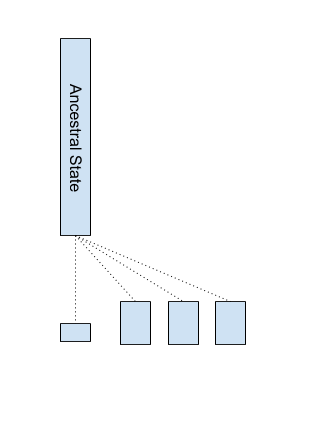
Figure: State of instances with a common pedigree

Let's take up that last question first. Suppose every morning I spawn 3 new copies of myself that step out the door and return in the evening to reconvene with my original copy that stayed home. In the evening, we discuss our experiences and somehow decide which of those to merge back into a collective "I" state that will be used to spawn new instances the next morning. Perhaps not all the experiences of my copies are to be incorporated into this collective "I". In that event, would the instance whose experience that day was discarded feel slighted or regretful? Not necessarily. Observe, the shorter the day, the less any single instance has to lose. Moreover, if this is something we've been doing everyday, would the exclusion of my experiences today hurt my feelings? Perhaps. Perhaps I met someone really charming that I don't want to forget but who, my other instances feel, is a bad influence. Maybe. Regardless, I think it's fair to assume such events will be uncommon, so the degree of in-fighting among my instances should not be unworkable (after all, we began the morning in identical agreement). I can imagine any copy of me having as much faith in this process, as say a person believing that they'll wake up following the nap they're about to take. Looking back, the last question is not well posed: every spawned instance sees itself as the instance that spawned the others. The question of mutiny, thus, becomes undefined: mutiny against whom?

As to the other questions, we approach from other angles in later sections.


Tape Awareness Overhead


The height of each block in the previous section's figure represents the storage overhead for an instance's state. The instances began the morning in their common "ancestral state"; at the end of the day, each spawned instance accumulated additional entropy. The space overhead for this additional state is represented by the branched blocks.

Now it should be clear that the scales are off in the figure: the overhead for the ancestral state must be much larger relative to a day's experience. But this observation naturally leads to the question What is the storage overhead for tape aware sentience itself?
Figure: Sentience overhead vs experiential data
Put another way, how much experiential state can we strip away from a tape aware instance and still leave its tape aware ability intact? This overhead, whatever it is, is bounded. In fact, it's likely a very small part of an instance's overall state.

Is there a universal sentience module that can be breath life into any block of experiential data in isolation? Probably not. An experience is contextual to a history: the incremental state change an "experience" represents is likely a function of the initial state; you probably can't just append this additional state to any old initial state. On the other hand, drawing on (extrapolating from) experience, I would still make much sense of today's experience even if some prior days were purged from memory a posteriori. So it seems reasonable to assume that for [most] any incremental block of experience there's a (lower entropy) base state smaller than the initial state that led to the experience that can still make "reasonable" sense of the experience.


Tape Aware Communications


How do tape aware instances communicate with one another? Do they ask questions and expect answers? Who does the answering?

Do tape aware instances just drop an answering copy of themselves around and leave it to the questioner to fire up? Perhaps. This strategy would make sense, for example, if the "2" instances were running at significantly different clock speeds--or if their host machines were spatially distant. On the other hand, much would be lost if the "answering instance" left behind were never able to share its Q&A experience with the instance that left it there. Perhaps this is a way establishing trust: load the other mind in the debugger and see what it's up to.

Are tape aware instances capable of feigning, lying, scheming, and other ills that afflict us mere mortal coils? Unlikely. An instance's thoughts are naked, its own schemes difficult to hide. If it's complicit in a scheme, only its maker can know; the instance itself would have to be a pawn. And intelligent pawns.. well, they're hard to manage.

The preceding discussion about blocks of experiential data was suggestive of a language. The closest analog to such a block I can think of is, say, an episode in the middle of a TV season. The format of the series itself constitutes a language. It certainly helps if I've seen the series premier, but I can still make much sense of an episode even in isolation. In a similar vein, I imagine tape aware beings developing a language for communicating thoughts and experiences, only more efficient, transparent, and immersive--more complete. (Note, however, unlike the TV episode format, you don't actually experience the passage of time; the effect here is more like an event you now suddenly remember having happened in the past. Think speed reading.) And just as with humans, their internal thoughts will be colored and structured by the language that expresses them. In this land of efficiency, thoughts are difficult to separate from their expression: expressions are thoughts.


Individuation: a Computation Strategy


In order to solve a difficult math challenge, I imagined a tape aware instance might spawn multiple instances of itself so that each could attack the problem from a different angle. I hope to justify briefly here why this individuation strategy is effective. For while it's obvious that the more angles considered, the better the odds of finding a solution, it's less clear why it can't be the same instance thinking through these multiple lines concurrently--like a clever multitasker. This question, it turns out, is kind of semantic in nature (apologies, in advance).

For in this context, what do we mean by multiple instances versus a single instance of the "same thing"? If instance's are distinguishable by the deltas of their states, then 2 instances of the same entity are distinguishable so long as they have not each merged the deltas of the other into their own. Put another way, the more instances chat with one another, the less distinguishable they become.

And what does it mean to entertain a thought? Does it not involve a conscious commitment in time to a train of thinking to the exclusion of other possible lines? Certainly, for the better you can set aside, exclude, the opposing ones, the more effectively can you entertain this one. Thus in order to multitask effectively, you must perform each concurrent task as if we it were being conducted in isolation. But if each task is to be directed by a mind (that is, a task requiring a degree of self-referentiality), then we might as well call the mind instance directing the task an individual.


God Mode: Principle of Subtraction


Moreover, why should the master conductor of an individuation strategy content itself with spawning near identical copies of a same entity for each assigned task? Perhaps, as with humans, a varied mix of experiences and know-how in each individual of the team is more promising. In that case, each individual cannot "know" everything, for otherwise, they'd be indistinguishable.

The zeitgeist of the tape aware realm, I imagine, is populated with blocks of experiential data each of which can be grafted atop a smaller set of base states in a dazzling array of combinatoric permutations. Not all blocks are comprehensible from a same base state: as more data blocks are added to a base state, there are fewer and fewer remaining (pre-recorded) compatible blocks that can be piled on. Conversely, looking back, a tape aware being can trace it's experiential lineage to an ancestral experience shared by many a contemporaneous individuated instance. That shared knowledge, experiential data--really, thus, figures more prominently the more individuated instances have it baked in their past. In other words, an individual's thought, their viewpoint, their experience acquires value if it later becomes part of the ancestral heritage of a large number of individuals.

Now it must seem that any tape aware instance should be able to assume the mind of another at will, like an all seeing god. But I have a nagging feeling that this is not quite like how we imagine a capable god. For this god can only entertain your viewpoint so long as it ignores those of others. It can only ever empathize abstractly: to feel you, it has to forget itself. A tape aware god may look on the individuals about it imagining it is managing an enterprise: if it spawned those instances itself, it may look upon the collective as its farm. Still, it would not be running the show; at best it could guide--no more than say Accounting or HR run the show at a technology company.

This subtraction conjecture must not sound altogether unfamiliar. Without darkness it's hard to perceive the light.

Closing Remarks 


I began this essay began with a faint promise to describe what machine sentience is like. I don't know if I've succeeded, but it may be useful to recap how we got here. We first considered whole brain emulation to justify that machine sentience is fundamentally possible. I then posited that sentience is a fundamentally social experience, that you need peers to see yourself distinct from your environment. I might have pushed the pedal too hard when I re-purposed the words "self aware" to include dumb single cell organisms: the intent was to delineate degrees of self awareness. We observed that an intelligent being (program, call it what you like) running on a computer, one that is capable of introspection, should soon map its own "biology" to machine op-code and be able to see itself in action in a debugger, as it were. I called such a program a "tape aware" being and posited that this ability puts such programs on a higher level of awareness than their human progenitors. Moreover, because they are able to adjust their "metabolic" rate (clock speed), this extra awareness extends to the time dimension: such beings may notice things that escape the human experience of time. I also considered individualism and individuation in the machine realm: would there be one master super intelligent copy of the program running the show, or would there be a society of interacting, distinguishable machine actors? I argued the latter is the natural order of things even in the machine world. Finally, I considered whether the machine beings could be supervised by a god program, and suggested that even if one existed, it would be one of many, a neutered one supervising a limited flock.

I hope that in weaving a web of ideas I begin to paint a picture of a coherent whole. I don't know how to attack this topic but from many sides and see what sticks. But if there is one take-away from this essay, I hope it is a recognition that in the machine world too, sentience can come well ahead of general intelligence. That is, if we want to get a handle on how our intelligent machines behave into the future, then we should observe their behavior in numbers.

~

I have other rough ideas about sentient intelligent machines. Thoughts I couldn't fit in a patchy essay that I wanted to finish. Some specifics to tease your interest in a next essay: what is super-intelligence? what are its limits? what is consensus and how does it intersect with knowledge? what of their material aspirations? and what about the fact that sentient machines are capable of c-travel?

Update

My next post deals with some of these observations above. On the intersection of consensus and knowledge.. well, I had to postpone that topic because it was too big. Tangentially, here's a flavor of that idea: it relates computer generated math proofs.


Tuesday, June 25, 2013

Passage into the Panopticon


 A certain quiet follows an inmate's discovery that he now lives in a panopticon, and that inmate now is the public at large. That's how I'd sum up reaction to Edward Snowden's recent public disclosures about NSA surveillance activities both here and abroad.

Instead of joining the messenger in screaming bloody hell, we are awed by how he's hunted down. The message is clear. That's how panopticons work.

Saturday, June 1, 2013

On Space Faring Scifi

I'm a scifi buff. A frustrated one. Why? Because I want the stories to be more believable. I'm sick of no one explaining to me, for example, how Captain Kirk gets to walk on his bridge. Make something up, for the love of .., err science. Work that gravity generating trilithium kool aid that circulates under the Enterprize's hull into the story!

So I've been entertaining a plot of my own. It involves extraterrestrial beings visiting present day earth. Now though I'm a poor storyteller, I know that a plot does not make a story. But with scifi, for me at least, the juice is more in the setting; the unfolding action is just an excuse to weave an ever more speculative backdrop. My approach is to first get this setting right, and worry about the story later. A bad strategy for authoring a story, I'll concede.

 Subluminal Settings


But back to the setting. However improbable it is, if it's to qualify as scifi, I think, then the plot must still be anchored in science. Or to put it another way, it should break few, if any, laws of physics, and ought not necessitate inventing new ones. And so it was that I decided to revisit the first cardinal rule of interstellar scifi travel, namely that of breaking the cosmic speed limit c--and relativity along with it.

The usual objection to alien vistors travelling at subluminal speeds, of course, is that even at speeds approaching c, merely visiting a neighboring star still takes awfully long: round trips are on the order of decades. In truth, it only takes long from the perspective of the star system the spaceship leaves behind; on the fast ship, [ship] time advances slowly, or equivalently, distances seem contracted. The down side, even on such short interstellar hops, is that by the time our travelers return to their home planet, their world will have passed them by. Their skills will have become outdated, loved ones aged, distant, or dead, friends moved on. Sure, an advanced civilization capable of near-c travel would certainly have great rehabilitation programs for their returning citizens; it might even honor them by hanging their ships in museums. Still, the physics of space travel would seem to make it a dreary business, the plot constrained and unforgiving.

(Now if the story's protagonist were to be a caricature of someone in the future who we can still relate with--perhaps a young, aloof outcast, set in her now ancient ways who reminds a future generation of long forgotten values--then we might use near-c travel, instead of the cryonic fridge, as the device that placed her there. But that would be another scifi genre.)

Perhaps we shouldn't be thinking of these alien visitors as space travelers at all; they're space-time travelers. No, they don't get to revisit the past; instead, they get to race forward into history. For all we know, they get to see the universe's chilly end. And our conception of a home planet, namely a place where a civilization is anchored to, is likely a tad bourgeois from their perspective.

Near-c Civilizations


Assuming our alien space-time travelers are in fact individuated, social beings (as opposed to mere extensions of some borg-like creature), how then are their civilizations organized? We're not ruminating here over such things as class hierarchy and such, but merely considering how its individuals interact. How do they keep time? Whatever the solution, they must be extra cautious with this dimension. For all the while they whiz back and forth across space, they can only race forward through "ambient" time.

To better appreciate the dynamics of near-c travel, let's consider two siblings on planet Ki who wish to embark on separate near-c journeys. They plan to rendezvous back on Ki after having each aged the same, say nine years. After much calculation, haggling and flight plan adjustments (their destinations are roughly the same distance), they agree to meet again after one hundred fifty-two years have elapsed back on Ki.

With near-c communities, a rendezvous involves not only specifying a time and place to meet, but also how old the parties will be when they meet. In our hypothetical example, the meeting time was given in local, Ki time, what I'm loosely calling ambient time, while each sibling's age was to be measured in their respective ship times. That the siblings planned to have aged exactly the same when they next met was just illustrative: maybe they ended up agreeing to age nine years, give or take a few.

So we see how two near-c travelers can possibly stay in touch; but can we extend it to a community? If the residents of Ki routinely travel to distant times and places at near-c speeds, then who's left to run the affairs of the planet they leave behind? Would there be any incentive to keep Ki humming? Maybe.

For if there's work to be done and goods to be traded, whether material or virtual, the ambient timers who choose to stay on Ki enjoy a huge advantage over their near-c brethren: though they age faster, or rather, because they age faster, they also get more done. If there's some sort of competition over limited societal resources, then, over time (anyone's time), these better placed (perhaps, generations of) ambient timers will corner those riches before their more youthful, less accomplished, near-c cousins can.

[Juxtapose that last paragraph against the near-c-ers perspective: harvesting technological change.]


On the Evolution of Intelligence


Let us now turn our attention to establishing an evolutionary narrative for these advanced extraterrestrial visitors. This exploration might both inform the setting in broad brushstrokes (the characteristics, diversity of the alien visitors, and how they came to be) and help lead the reader down a plausible path into an implausible setting.

(Though the typical scifi aficionado approaches a read with a healthy willingness to suspend disbelief, this goodwill is best not squandered. I think the near-future scifi genre owes some of its success to this same principle. Plots typically consume disbelief capital early on, say with the introduction one or two game changer technologies (The Truth Machine, Minority Report, I, Robot), which when grafted onto an otherwise familiar landscape, expose unexpected dichotomies, give rise to unintended consequences, present moral and philosophical challenges.)

If the emergence of intelligence marks an inflection point on the evolutionary path of life, then clearly these are early days here on earth, a four billion year old planet that of late (say the last ten thousand years) has hosted intelligent civilizations.

Elsewhere across the cosmos, our story goes, as indeed here in our milky way, conditions for the emergence of intelligence have been ripe in many a corner, and at many a time, both recently and in the distance past. We need not defend an estimate of how big this cosmological window in time is (you might need heavy elements, planets, and such): a mere billion year window should suffice for grounding a story in which many civilizations, perhaps most, survive their technological adolescence and advance to the near-c-er club.

But we are getting ahead of ourselves. The emergence of intelligence, the narrator explains, is a game changer not because of the outcome (intelligent, sentient beings), but because it marks the beginning of a change in process. The elemental drivers of the evolutionary process (natural selection, drift, etc.) are first mediated, then supervised, and eventually subsumed by a new driver, namely intelligent design.

Intelligent Machines


Every [intelligent] civilization, the story asserts, assuming it survives its early years, soon manufactures intelligent self-replicating machines. Here's an attempt at a half-believable sketch leading up to intelligent machines.

The Printer


If machine life was the next major evolutionary step after intelligent life, then the 3D printer must be the progenitor of all living machines. To be sure, the early models were not living at all; they were the agent, the primordial soup as it were, from which the new life form would emerge.

Some argue machine life begins at the point when the most advanced printers can only be constructed from other printed parts. Another view holds that early wet life industrialization marks the beginning of machine life. These arguments are well grounded, but we take a more practical approach: by the time wet life manufacturing is dominated by second order printed products, machine life has begun in embryonic form.

kk is the oldest documented kernel printer design by any wet life civilization that could print copies of itself. It could do very little else, of course, but it was the compiler that could now compile itself, the bootstrap on which ever more elaborate self replicating designs followed.

It's designers were well aware they had created a new life form: as long as intelligent wet life organisms found a design cute, there would always be versions of the object filling the real world. Though at the time (and place) it was widely acknowledged that a new evolutionary milestone had been crossed, it was discussed only in the abstract. After all, the printers could not grow without cooperating wet life.

But in every documented ecosystem, the technology soon overtakes the abstract. Printers become cheaper and ever more capable at printing at both the nano and macro scales. This ability to print at the nano scale facilitates the development of emergent capabilities. We see the printer designs start to flow out from nano scale features out to the macro scale.  Cultivating ever more individuated machines becomes a principal component of intelligent wet life economic activity.

If the printer was the physical embodiment of the this new life form, its DNA was the code that defined how to print it.

Actually, whether some such a narrative or another, one idea is that an intelligent machine's digital "DNA" not only describes its physical form, but also its mental (its learned) state. That is, it can print clones of itself, offsprings really, that each inherits the collective experience of its ancestors.

C Travel


But if it can clone itself locally, then perhaps an intelligent machine can also arrange to have a copy of itself printed at a remote location. As it beams its code to a printer parked at one of the remote galactic outposts, say a mere 20,000 light years away, the intelligent machine travels at the speed of light.

A troublesome side effect of this form of c travel is that you leave a copy of yourself behind.

~

We could go on, but I hope it's already clear you don't need to challenge physics with faster-than-c travel in order to write scifi about space faring aliens. Indeed it can be more interesting if you don't.


Related Stuff


Fermi's Paradox: "Where is everybody?"
Louis K. Scheffer (1994),  Machine Intelligence, the Cost of Interstellar Travel and Fermi's Paradox


Friday, April 1, 2011

A struggle to think about ideas

“Great minds discuss ideas; average minds discuss events; small minds discuss people.”
-Eleanor Roosevelt

Lately, I don't follow up much on ideas; instead I read the news about people with great ideas. I don't care much for such vicarious pleasures, but that is what's mostly on offer for a lazy reader such as myself.

~
Kicking yourself in the butt now and again is not a bad thing.